
Gun Laws in Arizona for Hunters
Regulations and Guidelines

Arizona's landscape offers an abundant and diverse range of wildlife, making it a prime destination for hunters. With this opportunity, comes a responsibility to understand the state's gun laws, which balance individual freedom with public safety. Arizona gun laws are known for their permissiveness. The state respects the rights of law-abiding citizens to carry firearms and has minimal restrictions on gun ownership and use compared to many other states.
One of the key aspects that hunters must be aware of is that while Arizona does not require permits for carrying firearms openly or concealed for individuals over the age of 21, it does have specific regulations that govern hunting practices. It is important for hunters to familiarize themselves with these regulations, which are outlined in the annual Arizona hunting regulations booklet published by the Arizona Game & Fish Department. This includes details on season dates, bag limits, and hunting types for various wildlife, including big game species such as deer.
Prospective hunters in Arizona must also keep in mind the peculiar regulation regarding ammunition purchases: Although firearms can be acquired from the age of eighteen, one must be at least 21 years of age to purchase ammunition. This detail is particularly relevant for younger hunters who might legally possess a firearm for hunting but would require someone of age to supply their ammunition. Keeping abreast of these laws ensures that hunting in Arizona is conducted ethically and in accordance with state legislation.
General Gun Laws in Arizona
Arizona stands as a state with notably permissive gun laws. Understanding the legal framework regarding firearms is crucial for hunters and residents alike.
Overview of State Firearm Regulations
In Arizona, individuals are not required to register firearms and there is no requirement to obtain a CCW (Carrying a Concealed Weapon) permit to carry concealed for those over the age of 21. The state also mandates background checks solely for commercial gun sales, not private transactions. It's important to highlight that under Arizona Revised Statutes (A.R.S.) § 13-3108, any interference with the lawful transportation or storage of a firearm is prohibited. Those convicted of felonies, referred to as prohibited possessors, are not allowed to possess firearms.
Age Limitations: 21+ for concealed carry without permit
Background Checks: Mandatory for commercial sales only
Prohibited Possessors: Including convicted felons, cannot possess firearms
Restoration of Rights: Possible through legal set aside or pardon
Understanding the Second Amendment
The Second Amendment of the U.S. Constitution protects the right to keep and bear arms, and Arizona law reflects this by respecting the rights of law-abiding citizens to both openly carry and concealed carry a handgun. Federal law operates alongside state regulations, providing a baseline for who may legally possess and use firearms.
Open Carry: Permitted for adults, no permit required
Concealed Carry: Permitted for those 21 and over, no permit required
Federal Law Alignment: Arizona's firearm laws align with federal standards regarding prohibited possessors
Gun Ownership Requirements

In Arizona, the legal framework governing the ownership of guns for hunting is rooted in respecting individual rights while maintaining public safety. Eligibility criteria are established to ensure responsible gun ownership, and background checks mitigate the risks associated with firearms sales.
Eligibility and Restrictions
Individuals must be at least 21 years old to legally own a handgun. Restrictions apply to certain groups; notably, prohibited possessors such as convicted felons or those adjudicated delinquent are not allowed to possess firearms. It is a felony for these individuals to have a gun, although restoration of firearm rights is possible through legal mechanisms like set asides or pardons.
Permit and License Information
Arizona does not require permits or licenses for the purchase of firearms, nor are they required to carry guns for the purpose of hunting. There is no state-specific permit or license necessary to purchase a hunting firearm, making the process straightforward for eligible individuals.
Background Checks and Sale Regulations
Background checks are mandatory for commercial gun sales. However, private sales of firearms in Arizona do not necessitate a background check. This is an important distinction for buyers to understand when purchasing a firearm for hunting, as it impacts where and from whom they can purchase their firearms.
It's important for hunters and potential gun owners in Arizona to be well-informed of these requirements and regulations to ensure they are complying with the law.
Carry Laws for Firearms

In Arizona, hunters must navigate specific regulations regarding the open and concealed carrying of firearms. These laws balance accessibility with safety in a range of public environments.
Open Carry Regulations
In Arizona, individuals 21 years or older may openly carry firearms without a permit. This includes handguns, rifles, and shotguns. For hunters, this means ease of carry when transitioning to and from hunting areas, provided they do not cross into prohibited locations.
Concealed Carry Permitting
Although Arizona law allows for concealed carry of firearms without a permit for those 21 and over, individuals under this age requirement—or those looking for reciprocity in other states—must obtain a concealed carry permit (CCW). For hunters, a CCW can be advantageous for carrying a concealed firearm for personal protection en route to a hunting site.
Prohibited Locations for Carrying Firearms
Certain areas in Arizona are designated as prohibited locations for carrying firearms, regardless of open or concealed status. These restricted areas include:
Polling places during elections
School grounds (K-12)
Federal buildings
Game refuges unless specifically permitted by the managing agency
It is imperative for hunters to familiarize themselves with these restrictions to ensure compliance with state laws while carrying their firearms.
Specific Provisions for Hunters
Arizona's hunting regulations demand careful attention to license requirements and the lawful use of firearms and ammunition. These provisions are designed to ensure sustainable wildlife management and safe, responsible hunting practices.
Hunting License Requirements
Every hunter in Arizona must obtain the appropriate hunting license for the type of game they intend to hunt. License types and requirements include:
General Hunting License: Required for all hunters, except those exempt by age or disability.
Youth License: Available for those under the age of 18 at a reduced cost.
Short-term Licenses: For hunters on brief visits to Arizona.
Licenses must be visible and on person during hunting activities.
Firearm and Ammunition Regulations for Hunters
Firearms and ammunition used in hunting are subject to specific state regulations:
Legal Firearms: Hunters must utilize lawful firearms for hunting, with regulations specifying permissible types for different game species.
Ammunition: Only approved ammunition types may be used, in compliance with Arizona's hunting regulations.
It is illegal to use firearms:
Within a designated safety zone.
Under the influence of alcohol or drugs.
With silencers, fully automatic mechanisms, or other restricted devices.
These strict regulations serve to promote both marksmanship and ethical sport hunting. Compliance is critical for any individual involved in hunting within Arizona's borders.
Firearm Transportation and Storage
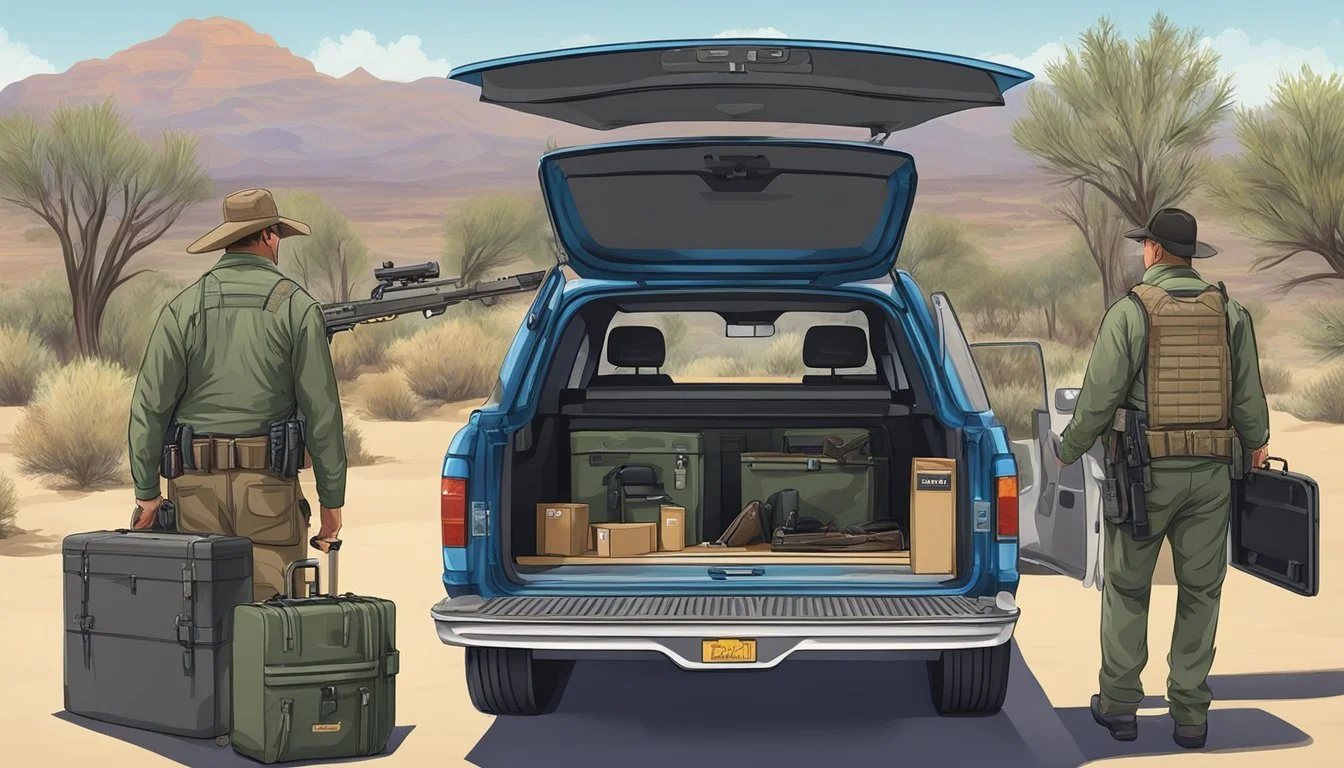
In Arizona, responsible hunters must adhere to laws governing the transportation and storage of firearms. These guidelines are critical for maintaining safety and respecting both legal boundaries and private property rights.
Vehicle Transportation Guidelines
Arizona law permits the transportation of firearms in motor vehicles, but specific regulations apply to ensure this is done lawfully. A firearm must be transported in a manner where it is not readily accessible if it is within immediate reach of any occupant of the vehicle without needing to exit the vehicle. Ideally, the firearm should be stored in a closed compartment within the vehicle, such as a glove compartment or console. If a person does not have access to a compartment, the firearm may also be transported in a case, holster, or scabbard that is carried in a lawful manner. It's important to note that the presence of a firearm within a vehicle on private property may be subject to that property owner's consent and applicable laws.
Safe Storage and Theft Prevention
For hunters, storing firearms safely is just as important as following the correct transportation protocols. In Arizona, firearms should be stored in a secure location to prevent unauthorized access and theft. Theft prevention becomes particularly important in the context of vehicle storage; hunters are encouraged to use lockable storage and practice discretion to minimize the risk of theft. When firearms are not in transit, using a gun safe or locking cabinet can provide an extra layer of security on private property. Additionally, the use of trigger locks or cable locks can prevent the firearm from being used if it does fall into the wrong hands.
The safe transportation and storage of firearms is not only a matter of legal compliance but also one of personal responsibility that enhances safety for all.
Restricted Actions and Entities

In Arizona, certain activities related to firearms are strictly regulated, especially concerning individuals under probation, parole, or possessing certain legal statuses. Federal and state laws converge to delineate these restrictions to ensure the safety and order of the community.
Unlawful Activities
Unlawful Possession: Individuals convicted of a felony or adjudged guilty except insane are prohibited from owning or possessing firearms. This also encompasses entities subject to a restraining order that was granted after due process and which explicitly prohibits firearm possession.
Interstate Transportation: A firearm or its parts and accessories cannot be transported into Arizona with the intent to commit a felony. Additionally, Arizona law targets fugitives from justice, disallowing them from bearing arms under state jurisdiction.
Probation and Parole Restrictions
Probation Status: Persons on probation are typically subject to firearm possession restrictions. Conditions of probation can include surrender of fire-arms and the prohibition on purchase or possession based on the nature of the original offense.
Parole and Interstate Compact: Parolees and offenders under the Interstate Compact are governed by specific conditions that may include the prohibition of firearm possession. Moreover, nonimmigrant aliens not in possession of a valid hunting license or other exemptions may not legally possess firearms in Arizona.
Arizona's Self-Defense Laws
In Arizona, individuals have the right to self-defense, and this right is articulated through specific statutes. These include the Castle Doctrine and the Stand Your Ground law, which provide legal justification for using force, including deadly force, in certain situations.
Castle Doctrine
Arizona recognizes the Castle Doctrine, which allows individuals to use reasonable physical force, including deadly force, when they have a legitimate belief of a threat to their life or safety within their home, vehicle, or place of business. Under this doctrine, there is no duty to retreat if faced with a situation where self-defense is necessary to prevent harm.
Location: Home, Vehicle, Business
Force: Reasonable Physical Force, including Deadly Force
Condition: Legitimate Belief of Threat
Duty to Retreat: None
Stand Your Ground Statute
The Stand Your Ground statute reinforces an individual's right to self-defense without the obligation to retreat. Arizona law (Section 13-404) stipulates that a person may stand their ground and use force, including deadly force, when they justifiably believe it is necessary to prevent physical harm or death.
Law Reference: Section 13-404, Arizona Revised Statutes
Force Used: Including Deadly Force
Condition: Justifiable Belief to Prevent Harm
Duty to Retreat: None
Both statutes emphasize the civil right to self-defense and do not require a person to inform an attacker of their intent to use such force. However, the actions must always be justifiable under Arizona law, emphasizing the importance of understanding the nuances of these legal protections.
Legal Implications of Non-Compliance

Non-compliance with Arizona's gun laws can lead to serious legal consequences, affecting one's freedom and the ability to engage in hunting and firearm activities. It is imperative for hunters to understand the specifics of these laws to maintain compliance.
Consequences of Violating Gun Laws
Unlawful Possession: In Arizona, it is a felony for certain individuals, such as convicted felons, to possess firearms. Being found in possession of a firearm when prohibited can lead to significant legal trouble, including potential imprisonment.
Detention Facility or Correction Facility Violations: Carrying a firearm into a detention facility or correctional facility is strictly prohibited without proper authorization and is punishable by law.
Penalties: The penalties for non-compliance can vary, including:
Fines
Imprisonment
Permanent loss of firearm rights
Processes for Legal Pardon and Reciprocity
Pardon: Individuals who have lost their right to possess firearms due to past convictions may seek a pardon or have their rights restored through judicial processes.
Restoration: The process typically requires a period of time to have passed since the conviction and a showing that the individual has not committed any further offenses.
Reciprocity: Arizona recognizes reciprocity agreements with other states concerning firearm laws, permitting hunters to carry firearms in accordance with both states' regulations.
Valid permits from reciprocal states allow for the possession and carrying of firearms in Arizona, under the guidelines established by law.
Additional Regulations and Information

In Arizona, hunters and gun owners must understand specific state laws governing private gun sales and the regulations detailed in the Arizona Revised Statutes. These laws affect how firearms are sold, who can possess them, and the handling of weapons in the state.
Private Sales and Gun Shows
In Arizona, private firearm sales and purchases at gun shows do not require a background check or firearm registration. However, both vendors and private sellers must not sell firearms to prohibited possessors, which include individuals convicted of felonies or domestic violence, those adjudicated as mentally ill, or those who are otherwise restricted by law from owning firearms. As per A.R.S. § 13-3102, firearm transactions between private parties are legal without the need for registration.
Specific Arizona Firearms Statutes
Arizona law has several specific statutes that address the carrying and possession of firearms. Under A.R.S. § 13-3112, the state outlines the requirements for obtaining a concealed carry permit. While Arizona does allow for constitutional carry, meaning no permit is required to carry a firearm openly or concealed, a permit is still available and recognized for those who wish to apply.
Regulations from A.R.S. §§ 13-401 to 13-421 cover various other firearms-related laws. These sections include laws around the discharge of firearms and the use of weapons during the commission of crimes. It is crucial to note that certain statutes have been repealed over time, so it is advisable for individuals to review the most current laws and ensure compliance. Regulations on silencers, automatic firearms, and other restricted devices must be adhered to, keeping hunting activities within legal boundaries.
This section delves into the aspects of Arizona's gun laws pertaining to the sale, possession, and use of firearms by hunters and other residents, highlighting the statutory framework within which they must operate.
Federal Laws vs. Arizona Statutes

Arizona's gun laws offer a unique approach compared to federal firearms regulations, especially for hunters, reflecting both a respect for constitutional freedoms and a distinctive state culture.
Comparing State and Federal Firearms Laws
Arizona, as a state, exercises its regulatory power to shape policies that differ from federal law in significant ways. Federal firearms laws function as the baseline regulations across the United States, establishing the foundational legal framework that states can then adjust, provided they do not infringe on federal stipulations.
Federal Law: It mandates background checks on firearms purchasers through licensed dealers, restricts certain individuals from owning firearms (such as convicted felons and those adjudicated as mentally defective), and regulates the possession and transfer of machine guns and other regulated firearms under the National Firearms Act.
Arizona State Law: It aligns with federal law in prohibiting certain individuals from owning firearms; however, it diverges significantly in its approach to the carrying and concealment of firearms. Arizona is known as a "constitutional carry" state, which means that individuals who are legally allowed to possess firearms can carry them openly or concealed without the need for a permit. This policy offers a broader interpretation of the Second Amendment within state boundaries.
Specific points where Arizona law differs from federal law include:
Concealed carry: While federal law does not address the issue directly, leaving it up to states to regulate, Arizona allows eligible individuals over the age of 21 to carry a concealed firearm without obtaining a permit.
Preemption: Arizona state law preempts local firearm regulations, ensuring state laws have dominance over municipal ordinances.
For hunters in Arizona, these statutes mean a more permissive environment regarding how they can carry their firearms during hunting expeditions. They are, however, still subject to federal regulations regarding hunting licenses, migratory bird stamps, and adherence to federally established hunting seasons.
Miscellaneous Provisions

In Arizona, specific regulations govern the modification of firearms and the materials from which they are constructed. There are also age-based restrictions that pertain to the purchase and use of firearms by individuals under the age of 18, as well as programs focused on youth education regarding safe firearm handling.
Firearm Modifications and Materials
In the state of Arizona, individuals are allowed to possess and use silencers or suppressors, as well as firearms made from a variety of materials. However, these items must not be visible in plain view without a proper carrying case, as Arizona law discourages displaying firearms in a way that may cause public alarm.
Silencers/Suppressors: Permitted in Arizona.
Materials: Varied; firearms can be made of different materials, including polymers.
Plain View: Firearms should be carried discretely to avoid causing public concern.
Age-Based Restrictions and Youth Education
Arizona law is precise when it involves minors and firearms. Individuals under the age of 18 may use firearms but must be supervised by a responsible adult. Additionally, Arizona supports educational programs that promote firearm safety among the youth.
Under 18: May only possess firearms under adult supervision.
Juvenile: Youth must demonstrate responsible behavior and understanding of firearm safety.
Youth Education: Supported and encouraged through programs and regulations.
Arizona's approach to these miscellaneous provisions reflects a balance between respecting individual rights and prioritizing public safety.
Frequently Asked Questions

Navigating Arizona's gun laws can be complex for hunters. Here, the most common concerns are addressed to help ensure compliance with state regulations.
Common Queries Regarding Gun Laws
Do hunters need to register firearms in Arizona? In Arizona, there is no requirement to register firearms. Hunters can use their firearms without a state registration process.
Is a permit required to carry a concealed weapon while hunting? For individuals over the age of 21, no permit is necessary to carry a concealed weapon; however, hunters should heed all applicable rules while in the field.
Are background checks mandatory for all gun purchases? Background checks are required for commercial gun sales. Private sales between individuals do not mandate a background check.
What are the age requirements for purchasing firearms and ammunition? Firearms can be purchased by individuals starting at the age of 18, but one must be at least 21 years old to legally purchase ammunition in Arizona.
Can non-residents hunt with firearms in Arizona? Non-resident hunters may use firearms if they maintain a foreign residence and possess the appropriate hunting license or permit.
Are there any restrictions for political subdivisions in regulating firearms? Political subdivisions in Arizona are generally preempted by state law from enacting firearms regulations that are more restrictive than state law.
What should members of hunting parties know about firearms use? Members should be aware that it is a felony for prohibited possessors, such as convicted felons, to possess a gun. Certain exceptions allow the restoration of this right.
How does Arizona law regulate the use of firearms on public lands? Hunters are allowed to use firearms on most public lands but must comply with specific regulations, such as discharge restrictions and seasonal limitations set by local authorities.
Emerging Trends and Changes in Legislation

Arizona has seen significant shifts in its approach to gun legislation, with recent movements in the state legislature indicating a trend towards more permissive gun laws.
Recent Amendments to Gun Laws
In Arizona, the legal landscape surrounding firearms is dynamic, with permitless carry already in place, allowing individuals to carry concealed handguns without a permit. The focus in recent legislative sessions has been on securing and expanding the rights of gun owners. This includes efforts to preemptively nullify any federal laws that may infringe on Arizonans' Second Amendment rights. For example, in April 2021, then Governor Doug Ducey signed the Second Amendment Firearm Freedom Act, reinforcing the state's declaration as a Second Amendment Sanctuary State.
In 2023, there were at least five gun bills proposed in the Arizona Legislature, three of which were introduced by Democrats. They chart a course for how guns are regulated in regard to public safety. Of particular interest to hunters, none of these proposals have focused on magazine capacity restrictions or specifically defined assault weapon laws, as Arizona typically offers a lenient stance on firearm ownership that includes long guns, a category frequently used by hunters.
Furthermore, Governor Katie Hobbs vetoed three pro-gun bills in April 2023, continuing the state's complex dialogue over gun regulation. While specifics about these bills were not provided, these actions indicate ongoing debates around gun laws and owner licenses that could potentially affect hunters and other gun owners. Despite these vetoes, Arizona has historically maintained relatively flexible gun laws, without stringent requirements like owner licenses specific to the purchase of firearms.
Gun owners in Arizona, including hunters, should stay informed of these evolving legal parameters to ensure compliance and to understand how their hunting practices may be affected by new legislation.

