Alcohol and Drinking Laws in Dallas County, Texas
Your Comprehensive Guide
Dallas County, Texas, presents a unique landscape of alcohol and drinking laws that residents and visitors alike must navigate. In accordance with state regulations, Dallas County enforces rules such as the prohibition of driving with a blood alcohol concentration (BAC) of 0.08% or higher. The laws become more stringent for commercial drivers, where the BAC limit is at 0.04%, and more so for individuals under the age of 21, for whom any detectable amount of alcohol is legally unacceptable. Furthermore, an open alcohol container in the passenger area of a vehicle is not permitted whether the car is in motion or stationary on a public road.
Within the diverse tapestry that forms the legal framework in the county, the sale of packaged liquor reflects specific restrictions tied to the time of day and the day of the week. For instance, while packaged liquor may be sold from Monday to Saturday between 10:00 a.m. and 9:00 p.m., these sales are not permitted on Sundays. By contrast, the sale of packaged beer and wine starts later on Sundays, with transactions only allowed from noon until midnight. These time constraints are less restrictive during other days of the week, when sales can occur from as early as 7:00 a.m. up until midnight.
Recent legislative changes demonstrate Texas's evolving stance on alcohol regulations. A notable amendment to the Alcoholic Beverage Code, for example, adjusted when Texans can purchase beer and wine on Sundays, highlighting the state's re-examination of its alcohol policies. As with any jurisdiction, the alcohol laws in Dallas County aim to balance the interests of public safety with personal freedoms and commercial enterprise, a balance that requires constant attention and periodic adjustment to reflect the community's standards and needs.
Historical Overview of Alcohol Laws

Dallas County has experienced a dynamic evolution in its approach to regulating alcohol, shaped by early 20th-century Prohibition policies and subsequent reforms. This section will explore the origin and transformation of these laws over time.
Prohibition and Its Aftermath
In the United States, the Prohibition era, lasting from 1920 to 1933, was a significant period during which the sale, production, and transportation of alcoholic beverages were banned nationwide. Texas was no exception, enforcing these legal restrictions rigorously. Following the repeal of Prohibition through the Twenty-First Amendment, Texas, including Dallas County, implemented its own set of alcohol regulations. These new laws often reflected local sentiments and varied substantially across different counties, leading to a patchwork of dry (no alcohol sales) and wet (alcohol sales allowed) areas.
The Texas Supreme Court played a role in interpreting and enforcing these post-Prohibition regulations, shaping how they were applied throughout the state. Frequently, the court would be called upon to clarify the legal frameworks that govern the distribution and sale of alcohol, ensuring that state laws conform to the broader mandates of the U.S. Constitution.
Recent Reforms and Amendments
Reform efforts, mainly driven by public demand and the need for modernization, have led to significant amendments to Texas's alcohol laws. In Dallas, the "wet-dry" distinction has historically been a hot topic, with some areas being completely dry, prohibiting the sale of alcohol, and others permitting it. The complexities of these laws made them a source of much debate.
Recent legislative updates have begun to dismantle these outdated frameworks. Certain antiquated regulations that date as far back as the 1930s have been called into question, leading to incremental changes. For example, petitions and ballot initiatives have increasingly been used to challenge old laws and introduce new ones that reflect contemporary attitudes toward alcohol consumption and sales.
Dallas County has seen specific reforms, such as changes to the legal requirements for the sale of beer and wine, which have become more lenient, thereby promoting business growth and consumer convenience. However, these laws continue to evolve, with ongoing discussions on how best to balance regulatory control with economic and social interests.
Legal Drinking Age and Minor Regulations
In Dallas County, Texas, the legal framework establishes firm age limits for the consumption and purchase of alcohol, along with specific exceptions for minors that are strictly regulated.
Age Restrictions and Enforcement
The Texas Alcoholic Beverage Commission (TABC) strictly enforces that individuals must be at least 21 years of age to legally consume or purchase alcoholic beverages. This regulation is supported by the Texas Penal Code, which classifies selling to or purchasing alcohol for a minor as a criminal offense. Enforcement of these laws is stringent, and violators can face serious legal consequences.
Selling Alcohol to Minors:
Offense: Class A misdemeanor
Punishment: Up to a $4,000 fine and/or up to 1 year in jail
Purchasing Alcohol for Minors:
Offense: Class A misdemeanor
Punishment: Fine and/or community service
Exceptions for Minors
The state of Texas does provide certain exceptions under which minors may legally consume alcoholic beverages. These exceptions strictly require the presence and direct provision of the alcohol by a responsible adult such as a parent, guardian, or spouse who is of legal drinking age.
Lawful Exceptions for Minors Consuming Alcohol:
In the visible presence of their adult parent, legal guardian, or spouse.
For religious ceremonies or practices.
When lawfully employed and required to handle alcoholic beverages.
These regulations aim to balance the legalities surrounding alcohol consumption with cultural and familial practices, upholding both the letter and spirit of the law with regards to minors and alcohol in Dallas County.
Operating Hours and Day Restrictions
In Dallas County, Texas, alcohol sales hours are regulated throughout the week, with specific considerations for weekends and public holidays. Enforcement of these regulations ensures that all establishments comply with the Texas Alcoholic Beverage Code.
Weekday and Weekend Sales
Monday to Friday: Sales of alcohol in licensed premises are permitted from 7:00 a.m. to midnight. Establishments can operate within these hours, ensuring availability for consumers while adhering to the state law.
Saturday: On this day, the window extends slightly longer. Sales start at 7:00 a.m. and continue until 1:00 a.m. the following Sunday.
Holiday Schedule and Exceptions
Several holidays dictate special restrictions for alcohol sales in Dallas County:
Sunday: Packaged beer and wine can be sold from noon to midnight. This presents a shorter sales period in comparison to other days.
New Year's Day, Thanksgiving Day, and Christmas Day: On these major holidays, the sale of packaged liquor is prohibited, which reflects the state's observance of these public holidays.
It is essential for businesses and consumers alike to be aware of these operating hours and day restrictions to ensure compliance with Texas laws.
Sales and Distribution
In Dallas County, Texas, the sales and distribution of alcoholic beverages are strictly regulated. Entities wishing to engage in the sale of alcohol must comply with state laws and obtain the appropriate licenses and permits.
Licensing for Sales and Distribution
To legally sell alcoholic beverages in Dallas County, businesses must acquire the correct type of license or permit from the Texas Alcoholic Beverage Commission (TABC). The specifics of the license or permit required will depend on factors such as the type of establishment, the kind of alcohol to be sold, and whether the sales are for consumption on or off the premises. For instance:
Grocery and convenience stores typically apply for a BG (Beer and Wine) permit for off-premise consumption.
Liquor stores require a Package Store Permit (P), allowing for the sale of liquor in addition to beer and wine for off-premise consumption.
Package Stores and On-Premise Sales
Package stores may operate between 7:00 a.m. and midnight Monday through Friday, and from 7:00 a.m. to 1:00 a.m. on Saturday. They are closed on Sundays, Thanksgiving Day, Christmas Day, and New Year's Day. Additionally, these stores are prohibited from operating on any election day until the polls close.
On-premise sale establishments, like bars and restaurants, must adhere to the hours set by the county. Typically, these include:
Monday to Friday: Sales are permitted between 7:00 a.m. and midnight.
Saturday: Sales can extend from 7:00 a.m. to 1:00 a.m. the following morning.
Sunday: Sales are generally allowed between noon and midnight.
Distributors, the entities that supply alcoholic beverages to retailers, must also maintain a valid license or permit to operate legally. These licenses include:
Wholesaler's Permit (W): Allows the sale of liquor to other wholesalers, package stores, and local distributors.
General Distributor's License (BD): Permits the sale of beer to retailers and the right to import beer for the ultimate sale to consumers.
Specific Local Regulations in Dallas
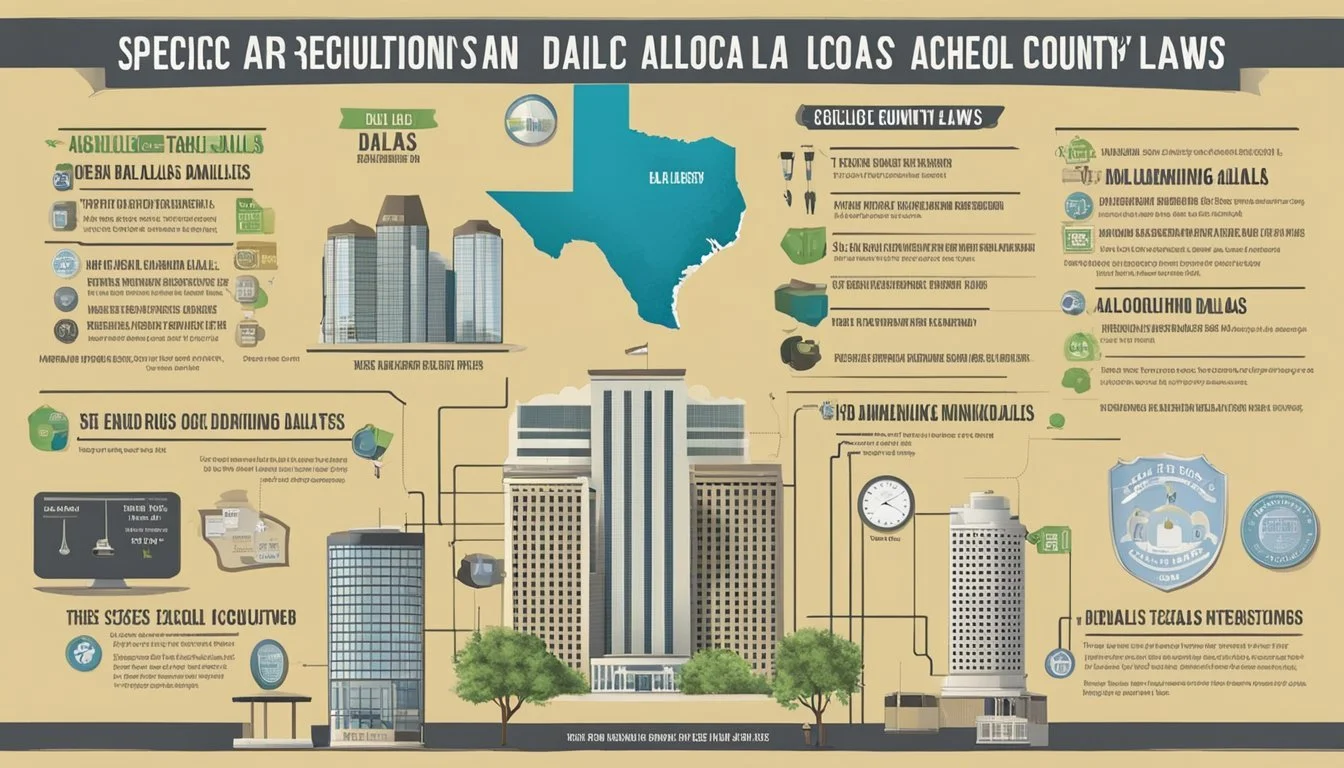
Dallas County enforces precise alcohol regulations, ensuring responsible consumption and sales within its jurisdictions. Different areas within the county, such as Addison and Fort Worth, have specific rules that cater to their local contexts.
Zoning and Proximity Restrictions
In Dallas, zoning laws dictate where alcohol sales can occur—most notably, distance requirements from schools and churches. For example, package stores must be located a certain distance away from these institutions, a common regulation within city limits.
Addison and Fort Worth Regulations
Addison follows the general alcohol laws of Dallas County, allowing sales of beer and wine in supermarkets and gas stations, with liquor sales restricted on Sundays. For bars and restaurants, alcohol can be served between 7:00 a.m. and 2:00 a.m. from Monday to Saturday, and noon to 2:00 a.m. on Sunday.
Fort Worth, while part of the larger Dallas-Fort Worth metropolitan area, has its own set of alcohol regulations. The city permits the sale of packaged alcohol from 7:00 a.m. to midnight from Monday to Saturday and noon to midnight on Sunday. Areas known as "wet areas" allow the sale of all alcoholic beverages, while "dry areas" may have restrictions or prohibitions on these sales.
Responsibilities and Legal Consequences
In Dallas County, Texas, adherence to alcohol regulations is strictly monitored by the Texas Alcoholic Beverage Commission (TABC), with significant penalties in place for violations. Businesses and individuals must navigate these laws carefully to avoid legal repercussions.
Business Compliance with TABC
Businesses in Dallas County must comply with the TABC code, which dictates when and how alcohol can be sold. For instance, retailers are subject to specific hours during which alcohol sales are permitted. Compliance also extends to the Cash/Credit Law, obligating businesses to adhere to state laws governing the purchase of alcohol for retail purposes.
Highlighted Responsibilities:
Adhering to state-defined hours for alcohol sales
Following the Cash/Credit law for alcohol purchases
Rigorous enforcement of underage drinking laws
Penalties for Violations and DUI
Violations of alcohol laws, including driving under the influence (DUI), carry severe consequences. The law is clear that individuals with a Blood Alcohol Concentration (BAC) of 0.08% or higher operating a motor vehicle can be charged with DUI. A peace officer has the authority to administer sobriety tests and determine the intoxication level.
Key Penalties for Violations:
Underage Drinking: Class C misdemeanor, fines up to $500, mandatory alcohol awareness classes, 8-40 hours community service.
DUI: Possible jail time, fines, driver's license suspension, and an ignition interlock device requirement.
It's imperative that both businesses and individuals remain vigilant about their responsibilities under the law to avoid these serious consequences.
Public Policies and Consumer Information

Public policies regarding alcohol in Dallas County, Texas, are designed to balance consumer rights with public health considerations. Information about these policies is accessible to the public, ensuring transparency and awareness.
Consumer Rights and Access to Information
Texans have the right to clear and accessible information regarding alcohol sales and regulations. State law mandates that information about rules and regulations is readily available, which is facilitated through the Alcohol Industry Management System (AIMS). This system provides details on licensing, alcohol-related laws, and the rights of consumers. For instance, Dallas County consumers can refer to the Texas Alcoholic Beverage Commission (TABC) website for FAQs and updates on alcohol laws such as the Cash/Credit Law and local option elections, which determine the types of alcohol sales permitted by city and county.
Local Option Elections:
City and County specific
Determine types of alcohol sales allowed
Consumer Information Access:
Through Alcohol Industry Management System (AIMS)
TABC website for regulations and FAQs
Impact of Policies on Public Health
The public health impact of alcohol-related policies in Dallas County is a major consideration in the drafting and enforcement of these rules. Strict drinking laws, rigorous DUI enforcement, and age verification requirements are examples of how legislation aims to minimize alcohol-related harm. Each bill considered in the House and potentially put to a vote is scrutinized for its potential consequences on public health. Additionally, regulations that dictate specific hours for alcohol sales based on the type of establishment are in place to manage consumption patterns and related health risks.
Public Health Considerations:
DUI enforcement
Age verification
Establishment Regulations:
Specific hours for alcohol sales
Type of establishment (bars, grocery stores, etc.)
Innovations and Recent Legislation

Recent legislative changes in Dallas County, Texas have introduced progressive adjustments enabling more flexible alcohol sales and marking significant industry modernization. Innovations facilitate consumer access to alcoholic beverages, while providing a regulatory framework that supports public safety and business operations.
Alcohol-to-Go and Delivery Services
In a notable move by Texas lawmakers, Gov. Greg Abbott signed a bill permanently allowing restaurants to offer alcohol-to-go services. This legislation solidified a temporary waiver first introduced during the COVID-19 pandemic, which was initially set to expire in May 2020 but was extended indefinitely. As a result, patrons may now order alcoholic drinks for delivery in conjunction with food purchases, broadening the scope for the alcohol industry to serve customers outside traditional settings.
Eligibility Criteria for Alcohol-to-Go:
Establishment must have a mixed-beverage permit.
Alcohol must be accompanied by a food order.
Permitted Beverages:
All types including malt beverages and cocktails.
Delivery Method:
Delivery can be done by the permit holder or a third-party service.
Modernization of the Alcohol Industry
A separate bill, Senate Bill 2284, greatly modernized the alcohol industry in Texas by allowing distillers to sell directly to consumers. Increased from two to four, distillers are now authorized to sell up to four 750-milliliter bottles of distilled spirits per month per customer for off-premise consumption. Additionally, the Texas Alcoholic Beverage Commission (TABC) introduced the Alcohol Industry Management System aimed at streamlining processes and improving regulatory oversight.
Direct Sales Adjustments:
Consumers can directly purchase a limited quantity of spirits from eligible distillers.
Industry Management Improvements:
The deployment of a digital system to manage licenses, permits, and reporting, enhancing industry accountability and management.