Alcohol and Drinking Laws in Titus County, Texas
A Guide to Local Regulations

Understanding the nuances of local alcohol laws provides residents and visitors with vital information to navigate the regulations successfully. In Titus County, Texas, alcohol laws can differ significantly between unincorporated areas and incorporated cities within the county. For example, each city, such as Mount Pleasant and Winfield, may have distinct ordinances regarding the sale and consumption of alcoholic beverages. The Texas Alcoholic Beverage Code governs these laws at a state level, with individual counties and cities tailoring their rules within that framework.
The sale of packaged alcoholic beverages is a prominent point of variation within Titus County. Certain areas might prohibit the sale entirely, while others may allow it under specific conditions or during particular hours. Restrictions are also in place for bars and restaurants; these establishments need to comply with regional directives that dictate when alcohol may be sold and consumed on the premises.
Additionally, unique consideration is given to minors regarding alcohol consumption. Texas law prohibits underage drinking and furnishes minors, as well as adults providing alcohol to minors, with clear potential consequences. Awareness of these laws is crucial, aiming to encourage safe and legal behavior in relation to alcohol use within Titus County.
History of Alcohol Laws in Titus County
Titus County, located in northeastern Texas, has a distinct history regarding its alcohol laws, reflective of both the state's regulations and local community standards. Following the national repeal of Prohibition in the 1930s, Texas established its Alcoholic Beverage Code, which governs the production, distribution, and sale of alcoholic beverages within the state.
Local Jurisdiction and Control Local control has been a significant feature of Texas's approach to alcohol regulation. Communities in Titus County, like much of Texas, have exercised their right to determine local alcohol laws through local option elections. These elections allow residents to vote on specific alcohol sales restrictions within their precincts.
Sales Restrictions In Titus County, the sale of packaged liquor is restricted. As per the local laws:
Packaged liquor sales are banned on Sundays.
On Monday through Saturday, liquor can be sold from 10:00 a.m. to 9:00 p.m.
Comparative Analysis The approach Titus County has taken towards alcohol sales, such as the prohibition of Sunday liquor sales, aligns with several other jurisdictions in Texas. In contrast, the state also has both "wet" counties where alcohol sale has fewer limitations, and "dry" counties where alcohol sales are highly restricted or banned altogether.
It is important to note that these regulations apply to the unincorporated areas of Titus County. Incorporated areas, namely cities within the county, may have their own set of rules governed by their respective city councils, adding another layer to the local governance of alcohol laws.
Overview of Texas Alcoholic Beverage Code

The Texas Alcoholic Beverage Code sets the legal framework for the regulation of the state's alcohol industry, encompassing all aspects from licensing to enforcement. It is enforced by the Texas Alcoholic Beverage Commission (TABC).
General Provisions
The General Provisions chapter defines key terms and lays the foundation for the applicability of the Code. Notably, "alcoholic beverage" is any beverage containing more than 0.5% alcohol by volume, which is intended for consumption.
Licensing and Permits
Obtaining a License or Permit is mandatory for entities wishing to participate in the Texas alcoholic beverage industry. The TABC oversees the issuance of various licenses such as for retailers, distributors, and manufacturers, ensuring adherence to state laws.
Regulations of Sales and Distribution
The Regulations of Sales and Distribution section stipulates clear guidelines for transactions involving alcoholic beverages. Critical points include permitted hours for the sale of liquor and the prohibition of sales on certain holidays.
Enforcement and Violations
The Code empowers the TABC to enforce Rules and Regulations and stipulate Violations penalties. It outlines the administrative hearing process, sanctions for non-compliance, and the Delinquent List for businesses failing to adhere to cash/credit law for the purchase of alcohol for retail sales.
Licensing Requirements in Titus County
In Titus County, Texas, businesses must adhere to specific licensing requirements to sell alcoholic beverages. Whether one operates a liquor store, bar, restaurant, or hosts events, obtaining the appropriate permit from the Texas Alcoholic Beverage Commission (TABC) is mandatory.
Types of Licenses and Permits:
Retailer's Permit (Off-Premise): Necessary for stores selling alcohol to be consumed elsewhere.
Examples: Liquor stores, supermarkets, gas stations
Mixed Beverage Permit: Allows establishments to serve drinks for on-premises consumption.
Examples: Restaurants, bars, hotel bars
Caterer's Permit: Required for events where alcohol is served temporarily.
The licensing process involves completing an application through the TABC's Alcohol Industry Management System (AIMS), which serves as the central hub for license and permit applications. The process is aimed to be straightforward, allowing applicants to save their work and return to it as needed.
Cost and Duration:
The cost of licenses and permits varies according to the type and scope of the business.
Licenses typically need to be renewed periodically, with details provided by TABC based on the specific license or permit.
Retailers in unincorporated areas of Titus County must remember that the sale of packaged liquor is prohibited on Sundays and is restricted to the hours between 10:00 a.m. and 9:00 p.m., Monday through Saturday. Compliance with these timing regulations is essential to maintain good standing with TABC and avoid penalties.
Sale and Purchase Regulations
Titus County, Texas, has specific regulations that govern the sale and purchase of alcoholic beverages. These regulations mandate the timings for the sale of beer and wine based on the day of the week, with distinct stipulations for Sundays.
Weekday and Saturday Sales
In Titus County, the sales of packaged beer and wine are permitted from 7:00 a.m. to midnight from Monday through Friday. On Saturdays, the hours extend slightly, allowing sales from 7:00 a.m. to 1:00 a.m. the following morning. These times apply to convenience stores, grocery stores, and other off-premises establishments. For on-premises establishments like bars and restaurants, the closing time may vary based on the specific business hours and local ordinances.
Sunday Sales Restrictions
Sunday sales are more restricted. Purchases of packaged beer and wine are only allowed between noon and midnight. These limits are important to comply with state and local laws. However, there are exceptions on certain holidays. For example, if New Year's Day, Christmas Day, or Thanksgiving Day falls on a Sunday, the sale hours might differ to accommodate celebrations. Additionally, licensed premises are allowed to begin selling alcoholic beverages, including liquor, at 10 a.m. on Sundays provided that it is served with food.
It is crucial for both consumers and retailers to be aware of these regulations to ensure legal compliance.
Operating Hours for Alcohol Sales
In Titus County, Texas, alcohol sales times are regulated by local laws. This varies based on the location (on-premise or off-premise) and the day of the week.
On-Premise Consumption
For on-premise consumption, such as in bars and restaurants, alcohol can be served up to 2 a.m. every night, provided the establishment has a late-hours permit. However, specific rules still apply for Sunday morning sales.
Sunday: Brunch patrons should take note that alcohol service begins at 10 a.m., if accompanied by food.
Monday - Saturday: Regular service hours are until 2 a.m., assuming a late-hours permit is held.
Off-Premise Consumption
Off-premise consumption sales, including liquor stores, supermarkets, gas stations, and convenience stores, adhere to the following schedule:
Sunday:
Packaged beer and wine: Noon to Midnight
Packaged liquor: No sales
Monday - Saturday:
Packaged beer and wine: 7 a.m. to Midnight
Packaged liquor: 10 a.m. to 9 p.m.
Exception: Saturday extends beer and wine sales to 1 a.m.
It's important for consumers to be aware of these hours to plan their purchases accordingly.
Age Restrictions and Minors
In Titus County, Texas, alcohol consumption and possession are legislated by clearly defined age restrictions, particularly when it concerns minors. The law draws a strict line for individuals under the age of 21 regarding access to and consumption of alcoholic beverages.
General Age Laws
Under Texas law, the legal age for purchasing and publicly consuming alcohol is 21. While minors are prohibited from these activities, Texas does have exceptions that allow a minor to consume alcoholic beverages under adult supervision, particularly that of a parent or guardian. It's important to recognize that these exceptions vary and are sometimes at the discretion of establishments.
Notably, Titus County does not fall under "dry county" regulations, allowing for the legal sale of alcohol; however, the provision of alcohol to minors is still tightly controlled. Possession and consumption by a minor outside of the private residence or without the consent and presence of a guardian is a violation of the law.
The Texas Alcoholic Beverage Code also regulates public intoxication and establishes that no person, regardless of age, should be in a state of public intoxication, which poses a danger to themselves or others.
Penalties for Violations
Minors in Titus County found in violation of alcohol-related laws can face several penalties. For instance, driving under the influence (DUI) with any detectable blood alcohol content (BAC) constitutes a Class C misdemeanor. Penalties for a minor's first offense can include:
A fine of up to $500
Mandatory attendance in alcohol-awareness courses
Community service
Suspension of driver's license
Furthermore, the act of making alcoholic beverages available to a minor is a serious offense. Those found guilty can face charges, fines, and even jail time. Businesses must meticulously adhere to these regulations to prevent any legal repercussions. This underscores the significance of responsible service and control measures within the county.
Legal Consequences and Penalties
In Titus County, Texas, individuals found in violation of alcohol and drinking laws face various legal repercussions. The laws applicable are consistent with Texas state regulations.
Driving Under the Influence (DUI): A person is legally intoxicated with a Blood Alcohol Concentration (BAC) of 0.08 percent. However, Texas imposes a zero-tolerance policy for drivers under 21, meaning any detectable amount of alcohol can result in a DUI charge.
Offense Penalty
First DUI Up to $2,000 fine, 180 days in jail.
Subsequent DUIs Fines increase, longer jail time.
Open Container Laws: Texas prohibits the possession of open containers of alcohol in vehicles. Violators can incur a fine.
Making Alcohol Available to a Minor: This Class A misdemeanor can result in a fine of up to $4,000, confinement in jail for up to a year, or both. Conviction leads to an automatic driver's license suspension for 180 days.
Public Intoxication: Classified as a Class C misdemeanor, public intoxication carries a penalty of up to $500.
Administrative Penalties: Aside from legal consequences, administrative penalties include suspension of driving privileges and mandatory community service.
These laws serve to protect the community and enforce responsible consumption of alcohol. Non-compliance not only endangers individual violators but also poses a risk to the broader public.
Special Regulations for Specific Entities
Titus County, Texas has tailored laws affecting how different entities can sell alcohol. Regulations differ notably between gas stations and large corporations, making it essential for businesses to understand their specific obligations and limitations.
Gas Stations and Grocery Stores
In Titus County, gas stations and grocery stores must comply with specific hours during which they are permitted to sell alcohol. Packaged beer and wine sales are regulated under strict timeframes. For instance, sales are not allowed on Sundays and are permissible from 10:00 a.m. to 9:00 p.m., Monday through Saturday. Stores like Walmart must follow these regulations, as they apply to all retailers of their type within Titus County.
Publicly Traded Corporations
Publicly traded corporations in Titus County, which typically includes large retail chains, may also be subject to these strict alcohol sales hours. However, they might operate under additional state laws that apply specifically to their business structures. Such corporations must not only adhere to the local county laws but also ensure they are in compliance with the Texas Alcoholic Beverage Commission's regulations that pertain to their broader operational scope.
Alcohol Content Regulation
In Titus County, Texas, the regulation of alcohol content is a crucial aspect of alcohol laws, ensuring that beverages comply with state mandates on alcohol by volume (ABV).
Beer and Ale
Texas law differentiates between beer and ale based on alcohol content. Beer is typically defined as a malt beverage with an ABV of up to 4% by weight, whereas ale exceeds this percentage. In Titus County, sales and distribution must align with these definitions.
Malt Beverage and Wine
Malt beverages and wine are also subject to regulation in Titus County. While malt beverages include both beer and ale, wine is specifically classified by its ABV, with Texas law generally defining wine as a beverage of up to 14% alcohol by volume. These distinctions determine the licensing required for sales and influence when and where these beverages can be sold.
Recent Legislative Changes

Titus County, Texas, has seen notable updates to its alcohol and drinking laws, reflecting changes at the state level. These modifications aim to address the evolving landscape of alcohol sales and consumption.
Alcohol Delivery
In Texas, House Bill 1518 played a pivotal role by legalizing the permanent sale of alcohol-to-go from restaurants. This is relevant to Titus County as establishments with a mixed beverage permit can now include alcoholic drinks with food orders for delivery or take-out.
Law Entity Affected Details
HB 1518 Restaurants with mixed beverage permits Permits alcohol-to-go with food orders
Sunday Alcohol Sales Amendment
The state legislature passed a bill that affects package stores in Titus County, allowing them to start selling alcohol on Sundays. Previously, such sales were prohibited, but the new law modifies this restriction.
Key Entities Affected:
Package stores
Change:
Extension of sale hours, now including Sundays
The amendment to Sunday alcohol sales represents a significant shift in Texas alcohol legislation, providing consumers with more flexibility and package stores with the potential for increased revenue.
Alcohol Regulation Across Nearby Counties
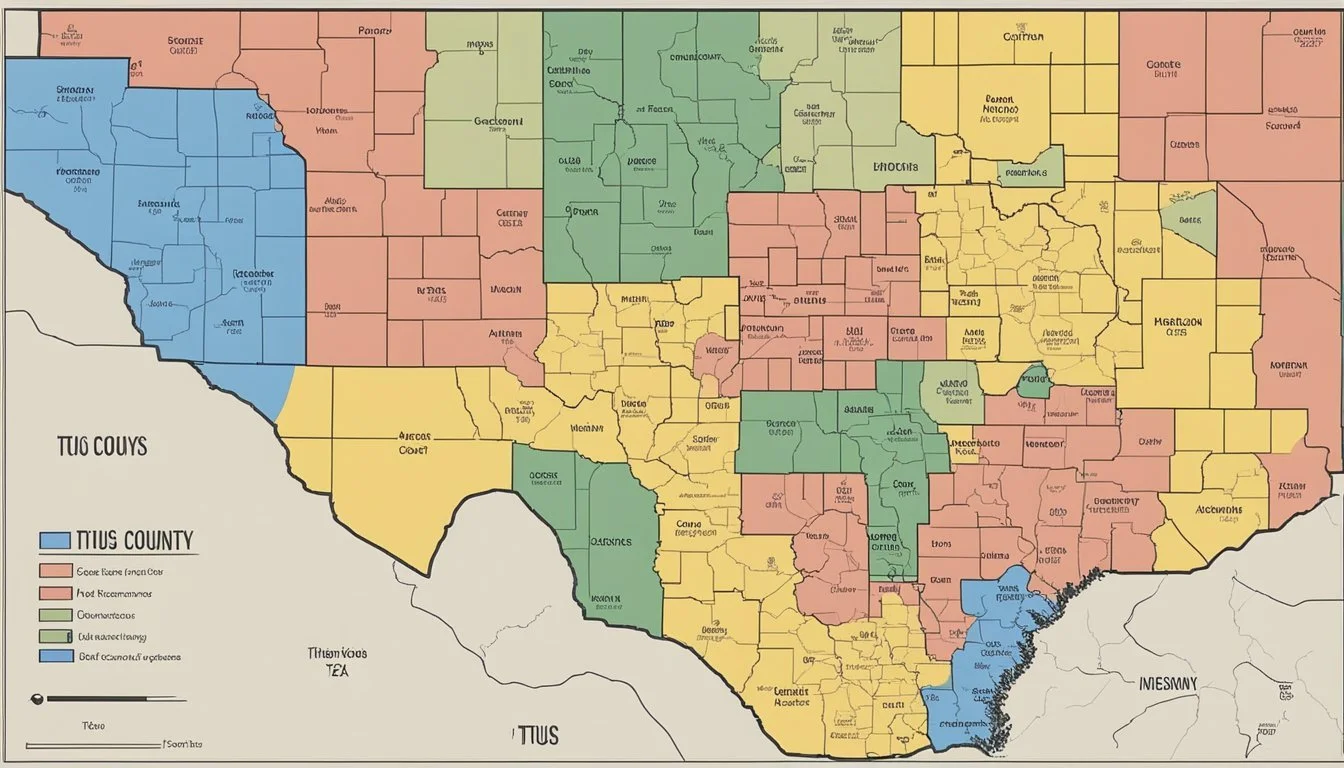
Local alcohol regulations in Texas vary by county, and even within counties, individual cities may have their own specific laws. The following subsections provide a concise overview of the regulations in counties adjacent to Titus County.
Franklin County
In Franklin County, the sale of alcoholic beverages is permitted, but specific regulations can vary based on local elections and ordinances. Franklin County is a 'wet' county, meaning that the sale of alcoholic beverages for off-premise and on-premise consumption is generally allowed, following state-regulated hours and licensing requirements. Cities like Mount Vernon have local policies that align with county laws.
Morris County
Morris County, which includes the city of Daingerfield, is also classified as 'wet.' This designation means that businesses are authorized to sell alcohol under the conditions set by the Texas Alcoholic Beverage Commission. Daingerfield, as the county seat, observes these regulations and may impose additional rules through city ordinances.
Camp County
Camp County, where the city of Pittsburg is located, has approved the sale of alcoholic beverages. Sales are regulated by the state but are subject to local provisions that can differ in application depending on whether they are within city limits or in unincorporated areas of the county.
Cities Within Titus County
Titus County oversees alcohol sales in its incorporated cities, including Mount Pleasant, the county seat. Each city may enforce its own regulations that can include:
Mount Pleasant: Sale of beer and wine for off-premise consumption is allowed every day except Sunday, with liquor sales restricted to specified hours from Monday to Saturday.
Talco & Winfield: Alcohol sales are permitted, with beer and wine available for purchase in gas stations and supermarkets. Liquor sales are not allowed on Sundays and are confined to set hours throughout the rest of the week.
These specific regulations ensure that while there is some consistency across the region, nuances in local alcohol laws can lead to a varied landscape of alcohol availability.