
From Temple Sacrifice to Steak
The Role of Meat in Religious Traditions
Meat has played a central role in religious practices for thousands of years, shaping cultures and beliefs from temple sacrifice rituals to everyday meals. Ancient societies often used animal sacrifices as a way to communicate with deities, mark important events, or express devotion. In many cases, the meat from these sacrifices became part of communal feasts, reinforcing social and spiritual bonds.
Over time, the meaning of meat in religious contexts evolved. Rules and discussions about eating meat offered to idols, seen in early Christian texts and Jewish traditions, highlight the ongoing connection between faith and food choices. Modern views on meat still draw from these deep traditions, whether in celebration, restriction, or reflection on the ethical meaning of eating animals.
Historical Roots of Meat Sacrifice
Meat sacrifice has served both spiritual and societal functions in numerous cultures. The slaughter and offering of animals linked communities to traditions, deities, and one another, laying the foundation for many ongoing religious and social practices.
Ancient Practices Across Civilizations
Animal sacrifice has been found in the records of Egypt, Mesopotamia, Greece, Rome, India, and Mesoamerica. In these societies, offerings often included cattle, sheep, goats, or birds.
For the Egyptians, bulls were sometimes dedicated to gods like Apis. Greeks offered animals at altars during festivals, emphasizing ritual purity and shared celebration. Roman religion used animal sacrifice during public events, with priestly officials distributing portions of the meat.
In ancient India, yajnas (sacrificial rituals) included animal offerings, especially for royal ceremonies. In Mesoamerica, cultures like the Maya and Aztecs used animal (and sometimes human) sacrifice to maintain order and appease their gods. Each society developed specific rules for who could offer, what could be offered, and how the meat was divided.
Origins of Animal Sacrifice
The roots of animal sacrifice often stemmed from the desire to communicate with the divine and secure favor or forgiveness. Early clans believed offering the best animals showed devotion and ensured blessings for harvests or victory in battle.
In Israelite tradition, as seen in the Torah and later at the Temple in Jerusalem, sacrifices were integral to worship. The process was highly regulated; only certain animals were acceptable and rituals were performed by priests. The meat did not go to waste—portions were offered to God, priests, or the community itself.
Outside of the Ancient Near East, sacrificial acts signified transitions: the founding of cities, coronations, or cycles in the agricultural year. Sacrifice was not just a ritual but a negotiation with unseen powers. These origins influenced later religious thinking about purity, morality, and communal responsibility.
Community and Religious Identity
Animal sacrifice was a communal act, reinforcing social bonds and clarifying roles within a group. In many traditions, the entire community would gather to witness and participate in the rites, sharing in the cooked meat as a sacred meal.
This shared consumption created a sense of unity and reinforced collective religious identity. In Jewish tradition, meat from sacrifices at the Mishkan or Temple was consumed in a holy context, while in pagan societies shared feasting created ties of loyalty both among people and with their deities.
These rituals often marked moments of atonement or celebration. The act of sacrifice set community members apart from outsiders by expressing distinct beliefs, values, and practices. Community, ritual, and identity were closely linked through the medium of meat and sacrifice.
Sacrificial System in the Hebrew Bible
Sacrifices in the Hebrew Bible were tightly regulated, with prescribed rituals for worship, atonement, and gratitude. Offerings were performed by priests according to detailed rules, focusing on the Tabernacle and later Temple as the central places for ritual.
Structure and Purpose of Offerings
The Torah outlines a structured system of offerings—korbanot—each with a distinct role and procedure. Sacrifices were brought to atone for sin, express thanks, fulfill vows, or maintain purity.
Offerings provided a framework for Israelites to interact with God through prescribed acts, symbolizing dedication, repentance, or gratitude. Specific instructions regarding animal selection, slaughter, and ritual handling are central throughout Leviticus, Exodus, and Numbers.
Certain offerings were mandatory, such as sin-offerings (chatat) and guilt-offerings (asham), while others, like the peace-offering (zevach shelamim), were voluntary. Each served not only the spiritual needs of individuals but also maintained collective ritual order and covenantal bonds.
Priests, Kohanim, and Ritual Duties
Priests (kohanim) held exclusive authority over sacrificial rites. Aaron and his descendants were appointed as the priestly class, tasked with officiating at the altar and ensuring ritual purity.
Duties included slaughtering animals, sprinkling blood, and burning portions on the altar. The priests received a share of specific offerings as their livelihood—sometimes portions of meat, grain, or bread.
Table: Priestly Duties and Offerings
Duty Description Slaughter Killing sacrificial animals Blood Sprinkling Applying blood to altar, symbolizing atonement Burning Portions Burning select parts per ritual rules Consumption Eating permitted portions (except for burnt-offerings)
Only kohanim could enter the sanctuary and handle sacred items. Failure to perform duties correctly risked severe consequences, as demonstrated by narratives involving Aaron's sons.
The Mishkan and Tabernacle Worship
The sacrificial system was centered on the Mishkan (Tabernacle), a portable sanctuary described in Exodus. The Tabernacle served as the locus for Divine presence, hosting daily offerings and festival sacrifices under strict guidelines.
Worship in the Tabernacle involved coordination between priests and lay worshippers. Rituals took place at the central altar and in designated sacred spaces, marked by precise schedules and procedures.
As Israel settled in the land, the Tabernacle's system later transferred to the Temple in Jerusalem. Both spaces embodied the ideal of centralized worship, consolidating sacrifices to a single national sanctuary where proper ritual order could be maintained.
Types of Sacrificial Offerings
The main categories of offerings included:
Burnt-Offering (Olah): Entire animal consumed by fire, symbolizing complete dedication.
Sin-Offering (Chatat): Brought for unintentional sins, focusing on purification and atonement.
Guilt-Offering (Asham): Required for specific transgressions and restitution cases.
Peace-Offering (Zevach Shelamim): Voluntary, shared by worshipper, priests, and altar.
Thanksgiving Offering (Todah): Given in gratitude for deliverance or blessings.
These korbanot used cattle, sheep, goats, birds, or fine flour, depending on the type of offering and the bringer's means. Each sacrifice required exact procedures for slaughter, blood application, and distribution between altar, priests, and sometimes the offerer, demonstrating the detailed nature of Temple ritual.
The Centrality of the Temple in Jerusalem
The Temple in Jerusalem stood as the spiritual and social heart of Jewish worship for centuries. The structure embodied religious law, tradition, and communal identity, shaping daily life and rituals for the Jewish people.
Role of the Temple in Jewish Life
The Temple in Jerusalem was the sole legitimate site for public worship and sacrifice in ancient Israel. Pilgrims from across the land gathered in Jerusalem during major festivals such as Passover, Shavuot, and Sukkot.
Its design was intended to reflect divine order. Physical layout, rituals, and ceremonies were prescribed in detail to maintain a sense of holiness and separation. Offerings made there symbolized atonement, gratitude, or celebration, connecting individuals and the nation to their faith.
The location in Jerusalem unified the people geographically and spiritually. Centralizing worship, as noted in Deuteronomy, helped curb idolatry and reinforced the authority of religious teachings and leaders.
Offerings and the Kohanim
Kohanim, the hereditary Jewish priestly class, played a central role in the sacrificial system. They conducted daily offerings, burnt sacrifices, and festival rituals according to biblical directives.
Types of offerings included burnt offerings (olah), grain offerings, and korban sacrifices, each with specific procedures and meanings. The kohanim ensured ritual purity and precision, acting as intermediaries between worshipers and God.
Listed below are common types of offerings:
Burnt offering (Olah): Entirely consumed by fire
Peace offering (Zevach): Shared by priests and worshipers
Sin offering (Chatat): Aimed at atonement
The kohanim’s responsibilities elevated their status in society. Their priestly service was both a religious duty and a symbol of tradition and continuity among the Jewish people.
Meat Sacrifice and Festivals

Ritual animal sacrifices play a central role in many religious traditions, linking food and faith through acts of devotion and communal gathering. Two important aspects are the Passover sacrifice with the paschal lamb and the practice of tithes and thanksgiving offerings.
The Passover Sacrifice and the Paschal Lamb
The Passover sacrifice is a foundational Jewish ritual marking the Exodus from Egypt. Each household would slaughter a paschal lamb at the temple, roast it, and eat it as part of a meal commemorating liberation. The law prescribed specific guidelines: the lamb had to be without blemish, slaughtered at twilight, and its bones left unbroken.
Families gathered to consume the lamb alongside unleavened bread and bitter herbs, as described in Exodus 12. Participation was mandatory for all Jewish people who were ritually pure, making this event a major point of communal unity. Historically, the shared meal emphasized both remembrance and obedience to divine commands.
Tithes and Thanksgiving
Tithes were systematic offerings of agricultural produce and livestock, representing a tenth of one's yield given to the temple and priestly class. Meat from these offerings was sometimes eaten in ritual meals, especially in thanksgiving sacrifices known as "zevach shelamim." These communal feasts allowed people to express gratitude to God for blessings received.
Thanksgiving offerings included not just animals but often bread and wine as well. Such meals fostered social cohesion, as portions were distributed among priests and ordinary members of the community. This practice balanced ritual obligation with the need to care for religious functionaries and the less fortunate.
Philosophy and Ethics of Sacrificial Meat
Sacrificial meat in Judaism reflects layered ideals about holiness, justice, and mercy, as well as changing attitudes to ethics. Close readings of sacred texts and influential thinkers like Maimonides reveal how these values shape practice and belief.
Jewish Values of Holiness, Justice, and Mercy
Jewish sacrificial practices, especially those involving meat, are rooted in the pursuit of holiness—elevating everyday acts to divine service. Levitical and Deuteronomic laws regulate sacrifice to stress order and prevent arbitrary ritual. Sacrifice involves justice through the strict rules that ensure fair distribution among priests and, at select festivals, the wider community.
Ethical mandates appear in laws such as not causing unnecessary pain to animals (tza'ar ba'alei chayim) and rejecting wanton waste. Mercy is practiced in the requirement to share sacrificial meat with the poor and strangers. The process itself, with blessings and intentions, is meant to transform consumption into an act of loving service (Avodah).
Critiques and Reforms in Sacred Texts
Prophetic texts—such as those by Isaiah, Amos, and Micah—famously critique rituals when separated from justice or compassion. Isaiah 1:11-17, for example, voices God's disdain for sacrifices performed without ethical living. The prophets insist that mercy and righteousness please God more than ritual alone.
Later Jewish writings, like the Psalms and Talmud, echo these calls for reform. They emphasize that sacrificial systems must foster goodness and love within the community. Ethical treatment of animals and humans is repeatedly foregrounded as essential to true worship.
Interpretation of Maimonides
Maimonides (Rambam), the medieval Jewish philosopher, viewed animal sacrifice as a transitional stage in religious development. In his Guide for the Perplexed, he argued that sacrifices accommodated ancient people's expectations but were meant to eventually yield to prayer and ethical action.
For Maimonides, the ultimate goal is holiness manifested through intellect and moral behavior, not ritual slaughter. He interprets sacrificial laws as a demonstration of mercy, limiting cruelty and excess. This approach places love, reason, and justice at the center of ideal Jewish practice, moving beyond the letter of the law to its ethical spirit.
Transition from Temple Sacrifice to Rabbinic Judaism
The end of animal sacrifices in the Temple in Jerusalem created a turning point in Jewish religious practice. The Jewish people had to adapt to a new reality, developing new rituals and methods for spiritual expression and connection.
After the Temple: A New Approach
With the destruction of the Second Temple by the Romans in 70 CE, animal sacrifices could no longer be performed. Priests—once central to religious life—lost their primary roles, and the religious center of gravity shifted from Jerusalem to local communities.
These changes prompted the development of Rabbinic Judaism, a new system focused on the study of religious texts and interpretation of Jewish law. Instead of centralized worship at a single holy site, Jewish life became anchored in synagogues, study houses, and communal gatherings.
Rabbis replaced priests as leaders and authorities, creating and teaching laws based on the Torah and the evolving Talmud. This approach enabled Jewish religious life to continue and spread, even far from Jerusalem.
Substitution of Prayer and Good Deeds
Without animal sacrifices, Rabbinic Judaism substituted prayer, Torah study, and ethical actions as central expressions of faith. Daily prayers, including the Amidah, were structured to recall the sacrifices once offered in the Temple in Jerusalem.
Public prayer and community service gained new importance. The rabbis taught that deeds of kindness and charity could atone for sins, serving as spiritual sacrifices.
Key substitutions:
Former Temple Practice Rabbinic Substitute Animal sacrifices Prayer, good deeds Pilgrimage to Jerusalem Local synagogue worship Priestly leadership Rabbinic authority
Jewish people came to see prayer and righteous acts as the main vehicles for spiritual growth, maintaining religious identity through study, ritual, and ethical living.
Meat in Greco-Roman and Pagan Religious Rituals
In the Greco-Roman world, animal sacrifice played a key role both in worship and social gatherings. The religious significance of these offerings shaped the culture’s attitude toward meat consumption and communal life.
Worship and Offerings to Pagan Gods
Animal sacrifice was central to idolatrous practices and religious ceremonies. Offerings of bulls, goats, or sheep were made at altars dedicated to a variety of pagan gods, from Zeus and Apollo to lesser-known deities. The rituals often involved the slaughter of animals at temple complexes or in designated sacred spaces.
A portion of the meat was burned as an offering to the god, while priests kept a share as compensation. Sacrifices were performed for specific purposes, such as securing favor for harvests, health, or military campaigns. These practices reinforced the connection between worshipers and gods and were seen as vital acts of devotion.
Public sacrifice was a visible, communal act. The involvement of large crowds, along with music and prayer, emphasized the collective nature of idolatry in the Roman world.
Community Feasts and Festivals
After sacrifices, large amounts of meat remained and were rarely wasted. Often, this meat was distributed among participants or sold in markets, making temple-sacrificed meat a common part of daily life. Community feasts were organized around these sacrificial events, turning religious rituals into public celebrations.
Festivals in honor of pagan gods, such as Saturnalia or the Eleusinian Mysteries, involved shared meals where sacrificial meat was a main feature. Participation in these festivals fostered social bonds and reinforced communal identity. In urban centers, it was estimated that much of the meat consumed by the population had first been offered in a religious context.
These social dimensions of ritual sacrifice blurred the lines between religious and secular life, making idolatrous practices relevant far beyond temple walls.
Meat Offered to Idols in the New Testament Context
Meat offered to idols (eidolothuton) was a matter of active debate within early Christian communities, particularly in cities connected to pagan temple practices. The challenge centered on how new believers navigated daily life in societies where religious and social customs were deeply intertwined.
The Dilemma in Corinth
In Corinth, meat sacrificed to idols was common at both public markets and social gatherings linked to pagan temples. Many Christians faced situations where meat from such sacrifices was the only food available at feasts or was sold in the market after temple rituals.
1 Corinthians addresses these complexities directly. The apostle Paul instructed the Corinthian church on how to respond, recognizing that idols, in themselves, had no real power. However, he stressed that participation in temple meals might give the impression of endorsing idol worship.
Paul explained that while eating this meat was not inherently sinful, knowingly partaking in idolatrous festivals or temple banquets risked being seen as complicit in pagan rituals. This distinction was important to both the believers' conscience and their public witness.
Ethical and Communal Implications
The early Christian response was shaped by both ethical and communal concerns. For some, consuming eidolothuton jeopardized their spiritual integrity or caused confusion for "weaker" believers who viewed any association with idol practices as deeply wrong.
Paul emphasized consideration for others over personal rights. He highlighted the possibility of leading another believer to stumble by exercising freedom without regard for others' convictions.
The church was encouraged to avoid eating meat offered to idols when it risked harming the community or validating idol worship. Abstaining, especially when the meal had clear connections to temple rituals, showed respect for differences of conscience and protected the integrity of Christian fellowship.
Controversies and the Jerusalem Council
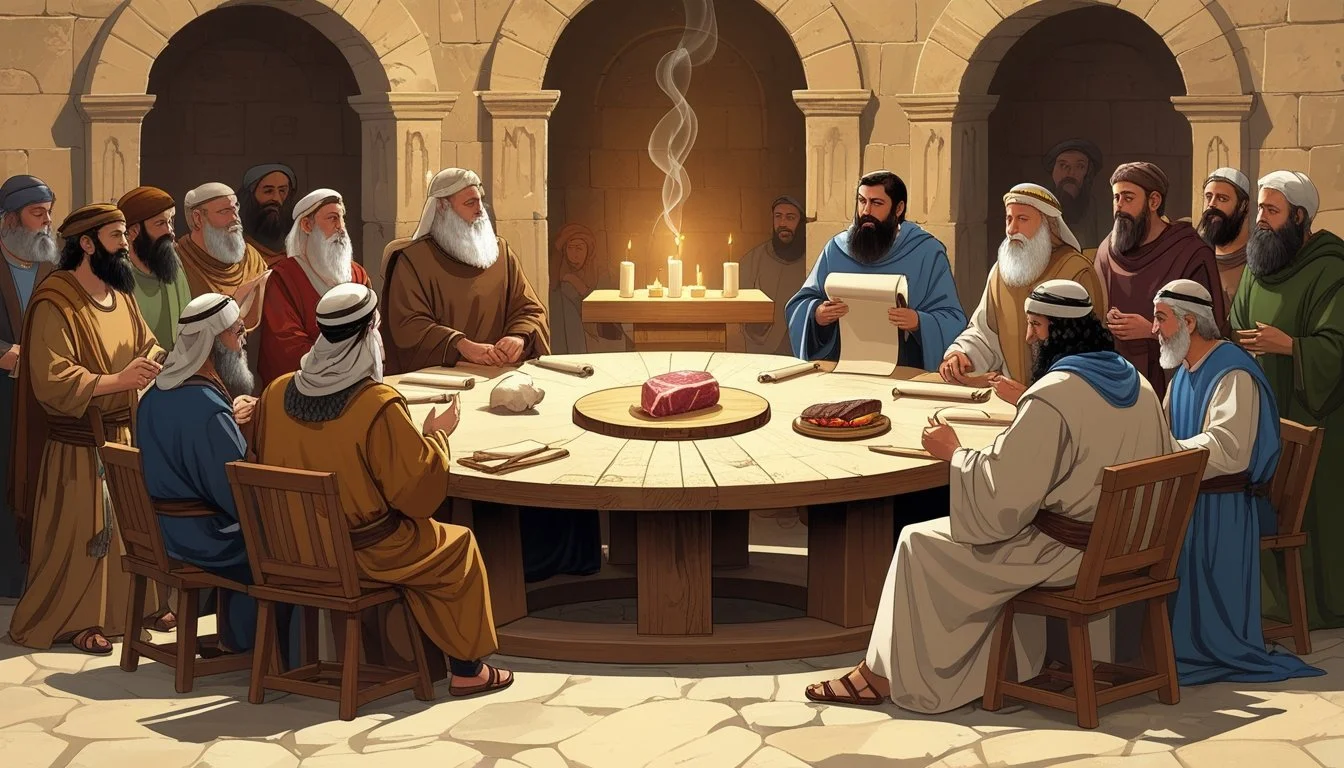
Jewish and Gentile Christians disagreed sharply about religious practices, especially around eating meat sacrificed to idols. This issue led to major debates on communal unity, ritual purity, and the requirements of the New Testament faith.
Acts 15 and Early Church Decisions
In the mid-first century, the early Christian community faced tension between Jewish and Gentile believers. Many Jewish Christians were concerned about maintaining traditional Mosaic laws, especially dietary restrictions and ritual purity.
The Council of Jerusalem, as described in Acts 15, was convened in response to these disputes. Leaders such as James, Peter, and Paul met in Jerusalem to decide whether Gentile converts needed to follow the full Mosaic law, including circumcision and food laws.
The council concluded that Gentile believers did not have to adopt the entire law of Moses. Instead, specific guidelines were set. The main requirements included abstaining from food sacrificed to idols, blood, meat from strangled animals, and sexual immorality.
These decisions both relieved Gentile converts of many burdens and sought to maintain peace with Jewish Christians. A clear distinction was maintained between cultural tradition and the essentials for inclusion in the Christian community.
Guidelines on Food and Worship
The guidelines issued by the Jerusalem Council directly addressed food and worship practices. Eating meat sacrificed to idols was a prominent concern, as it was linked to idolatrous rituals common in pagan temples at the time.
A list of prohibitions was established:
Requirement Reason Abstain from food sacrificed to idols Prevent idolatry and offense Abstain from blood Uphold ancient laws on purity Abstain from strangled animals Avoid ritual impurity Abstain from sexual immorality Moral and social cohesion
These restrictions balanced the need for religious purity with the realities of multicultural fellowship. The council’s rulings were designed to foster unity, respect Jewish sensitivities, and clarify the core ethical expectations for all believers, as seen throughout the New Testament.
Pauline Perspectives On Meat Sacrifice

The Apostle Paul’s letters address whether Christians should eat meat sacrificed to idols, a practical issue in ancient cities such as Corinth. His responses reflect a nuanced approach that weighs individual liberty against communal responsibility.
Teachings in 1 Corinthians 8 and 10
In 1 Corinthians 8, Paul acknowledges that idols have no real existence and that eating such meat is not inherently sinful. He states, “Food does not bring us near to God; we are no worse if we do not eat, and no better if we do.” This teaching emphasizes knowledge and conscience over ritual concerns.
However, in 1 Corinthians 10, Paul warns against participating in pagan temple feasts. He writes that while “everything is permissible,” not everything is beneficial or constructive. Paul draws a line between private consumption and direct involvement in pagan worship ceremonies, warning against any actions that may imply endorsement of idolatry.
Balancing Freedom and Responsibility
Paul insists that believers’ freedom must be balanced by concern for others’ consciences. If eating meat sacrificed to idols could cause a fellow believer to stumble or fall back into pagan practices, Paul advises abstaining. He famously declares, “If what I eat causes my brother to fall into sin, I will never eat meat again.”
This approach creates an ethic where personal liberty is limited by love for others. For Paul, the spiritual well-being of the community outweighs individual rights. Lists or charts highlighting Paul’s points emphasize this dual focus:
Principle Concern Knowledge/Freedom Eating is not sinful in itself Responsibility Avoid actions that harm or confuse fellow believers Worship Boundaries Do not participate directly in pagan rituals or celebrations

