
Gun Laws in Texas for Hunters
Understanding Regulations and Requirements

Texas has a unique set of gun laws that affect hunters in various ways. When preparing for a hunting trip within the state, it's crucial for hunters to be familiar with the specific regulations that govern firearm usage and hunting practices. These laws are designed to ensure safety, conservation, and ethical hunting behaviors.
Local and state entities, including the Texas Parks & Wildlife Department, establish seasons, means and methods, and hunting regulations that include restricted areas in counties and specific rules regarding the disposal of game. Hunters are expected to respect these rules, which can have legal implications such as fines or more severe penalties for violations.
Understanding Texas gun laws is essential, especially when they intersect with hunting activities. For instance, users of firearms must be aware of legal transportation methods, the significance of designated hunting areas, and the complete prohibition of hunting in certain wildlife sanctaries and state or national parks unless under specific circumstances. This legal framework aims to balance the rights of gun owners with public safety and wildlife preservation efforts.
Overview of Texas Gun Laws

Texas is known for its strong support of the Second Amendment and has passed various laws governing the use and possession of firearms. These laws coexist with federal regulations and are important for hunters and other gun owners to understand.
Gun Ownership Requirements
In Texas, as of September 2021, individuals are not required to have a license to carry a handgun in public, either openly or concealed. However, certain requirements must be met to own firearms:
Age: Must be at least 18 years old to purchase rifles and shotguns, and 21 for handguns.
Background: No felony convictions; background checks are necessary when buying from licensed dealers.
Mental Health: No firearms for individuals judicially declared incompetent or committed to a mental institution.
Training: While no longer mandatory for carrying, training is recommended for safe handling and knowledge of laws.
Types of Firearms Regulated
Texas allows most types of firearms; however, it regulates them as follows:
Handguns: No license required for carrying since 2021.
Rifles & Shotguns: No state registration, permitting, or licensing.
Automatic Weapons: Federally regulated and require ATF approval.
The Texas Penal Code and local regulations are preempted by state law, ensuring uniformity in gun laws across the state. Texas has asserted its status as a Second Amendment sanctuary, opposing federal overreach on gun rights.
Licensing and Carry Regulations
In Texas, hunters must navigate a series of laws concerning the licensing and carrying of firearms. The state has specific regulations for handgun licensing, permitless carry, and adheres to federal guidelines and reciprocity agreements.
Handgun Licensing and LTC
The Texas Department of Public Safety oversees the handgun license process. Texans seeking a License to Carry (LTC) a handgun must complete a state-approved safety course, pass a background check, and meet age and eligibility requirements. Prior to House Bill 1927, a license was mandatory for carrying a handgun publicly in Texas.
Permitless Carry and Open Carry
Following House Bill 1927, Texas law allows permitless carry for individuals over the age of 21. This means Texans can carry a handgun openly or concealed without an LTC, provided they are legally permitted to own a firearm. However, certain areas remain off-limits to firearms, whether an individual is carrying with or without a license.
Open Carry: Legal in Texas with restrictions on locations.
Permitless Carry: Applies to handguns for eligible individuals 21 years or older.
Reciprocity Agreements and Federal Regulations
Texas recognizes handgun licenses issued by other states, subject to reciprocity agreements. Texans with an LTC can carry a handgun in states that recognize Texas' LTC under the same agreements. Nonetheless, all firearm carriers in Texas must adhere to federal gun laws.
Federal Gun Laws: Supersede state laws and impose their own set of restrictions and regulations.
Reciprocity Agreements: Allow the recognition of Texas LTCs by other states.
By understanding Texas hunting laws—particularly regarding handgun licensing and carry regulations—hunters can ensure they remain compliant while participating in their sport.
Purchasing and Transfer of Firearms
In Texas, hunters looking to purchase or transfer firearms will navigate a set of laws that cater to both state and federal guidelines. Key points they need to be aware of are the requirements for background checks, protocols for private sales, and the necessity of record-keeping.
Background Check Requirements
When purchasing a firearm from a licensed dealer in Texas, the buyer must undergo a background check as mandated by federal law. This check is conducted through the National Instant Criminal Background Check System (NICS). Background checks are required for both long guns, such as rifles and shotguns, as well as handguns. However, the so-called "gun show loophole" enables private sellers at gun shows to sell firearms without conducting a background check on the buyer.
Private Sales and Gun Shows
Private firearm sales, including those occurring at gun shows, do not require a background check in Texas, which can be seen as a loophole in the system. While there is no state-mandated background check for these transactions, both parties must still comply with federal law. It is essential for a seller to note that they may not sell a firearm to a minor, someone convicted of a felony, an individual with an active protective order against them, or a person who is intoxicated.
Firearm Registration and Record Keeping
Texas does not require the registration of firearms when bought or sold. However, keeping records of firearm transactions is prudent for legal and personal documentation. For tax purposes, Texas offers a sales and use tax exemption for the purchase of firearms, which includes handguns and long guns. When transferring a firearm, there is no legal obligation to notify law enforcement as long as the transfer aligns with all applicable laws.
Firearms in Public Spaces
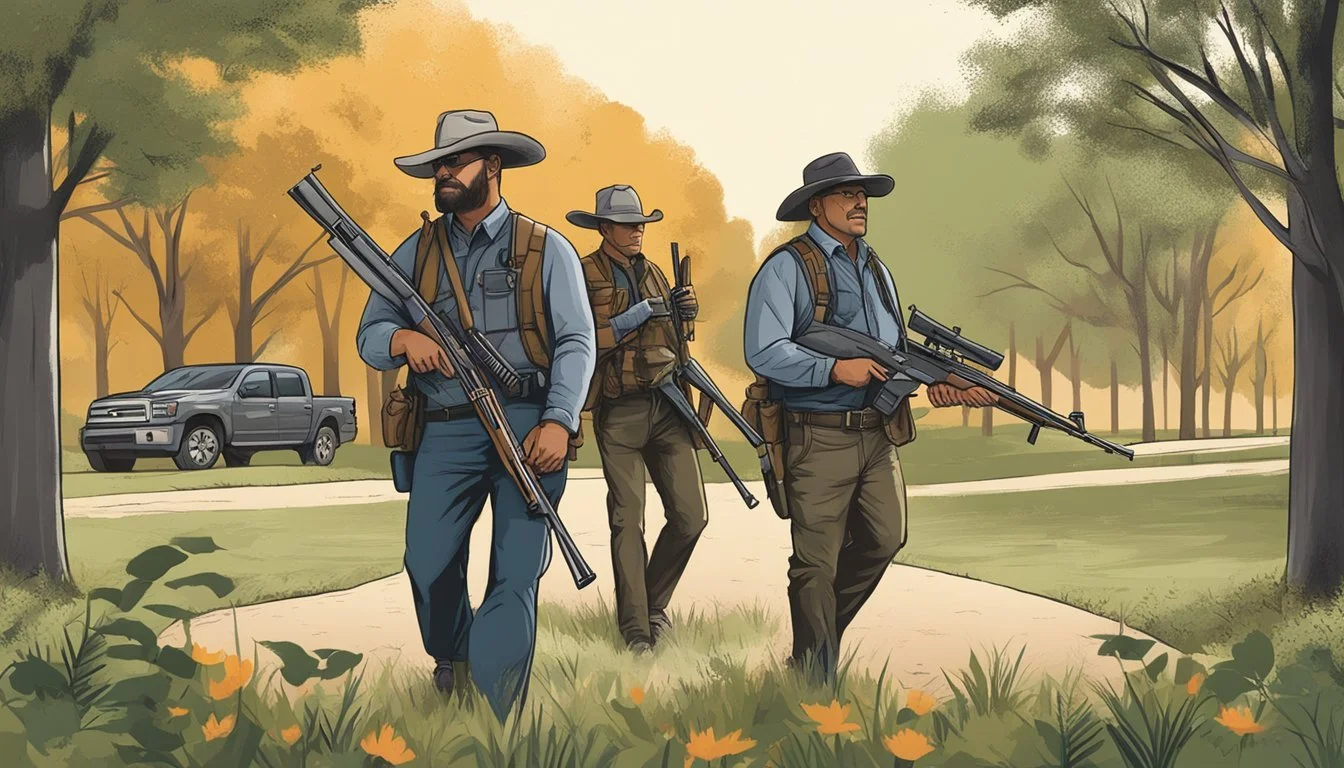
In Texas, regulations on firearms in public spaces involve careful distinction between private and public property, as well as understanding restrictions in sensitive areas. Carrying a firearm visibly or concealed requires adherence to specific guidelines, which vary by location and context.
Carrying on Private and Public Property
Private property owners in Texas have the right to set their own rules regarding the carrying of firearms on their premises. For public property, firearms can generally be carried openly or concealed if the individual possesses the appropriate license. Here are the key factors:
Open Carry: Non-prohibited individuals may openly carry long guns without a license. Handguns, however, must be carried in a belt or shoulder holster and require a License to Carry (LTC).
Concealed Carry: With an LTC, a person may carry a concealed handgun in most public areas.
Vehicles: Licensed individuals may carry a visible or concealed handgun in their motor vehicle, provided the firearm is not in plain view unless they are using a belt or shoulder holster.
Restrictions in Sensitive Areas
Certain locations are designated as sensitive areas where firearms, whether carried openly or concealed, are subject to stricter regulations or outright bans:
Schools: Firearms are generally prohibited on the physical premises of a school or educational institution, as well as premises where a school-sponsored activity is taking place.
Polling Places: Carrying firearms is banned during times of voting at polling places.
Government Courts: Firearms are not allowed on the premises of any government court or offices utilized by the court, unless pursuant to written regulations or written authorization of the court.
Racetracks and Amusement Parks: Both racetracks and amusement parks are also designated as sensitive areas, prohibiting carrying firearms.
Places of Religious Worship: Places of religious worship historically restricted firearms but changes in the law now allow them unless the place of worship provides effective oral or written notice prohibiting them.
It is essential for individuals to verify any location-specific rules and the precise legal text, as laws and provisions are subject to change and local jurisdictions may have additional regulations.
Prohibited Conduct and Penalties

Texas gun laws dictate specific prohibited conduct regarding the use of firearms by hunters, with corresponding penalties ranging from misdemeanors to felonies depending on the severity of the violation.
Criminal Offenses Involving Firearms
Unlawful Possession of a Firearm: Individuals convicted of a felony may not possess a firearm before the fifth anniversary of their release from confinement or community supervision. This is extended to those with domestic violence convictions who are banned under federal law.
Carrying in Prohibited Places: It is illegal to carry a firearm onto the premises of a school, hospital, amusement park, or a bar that derives 51% or more of their income from the sale of alcohol. Airports have designated zones where carrying a firearm is also prohibited.
Other Prohibited Conduct:
Possession while intoxicated: Being in possession of a firearm while intoxicated is considered a Class A misdemeanor.
Discharge in a municipality: It is against Texas law to discharge a firearm in a municipality with a population of more than 100,000.
Use of restricted weapons: The use of a machine gun or an explosive weapon for an offense is a felony, as specified by the Texas Penal Code.
Penalties for Firearm Misuse
Misconduct Penalties: The penalties for illegal carry and possession can range from a Class C misdemeanor to a felony. A Class C misdemeanor may result in a fine, while a felony can lead to imprisonment.
Enforcement: The enforcement of these penalties falls under the jurisdiction of local law enforcement agencies and is governed by the Texas Code of Criminal Procedure.
Execution of Penalties: When a hunter is found guilty of disorderly conduct with a firearm, like discharging in a public place to the alarm of others, the enforcement and execution of penalties are immediate, including arrest and possible jail time.
Penalties are strictly enforced, as Texas takes its gun laws seriously, particularly concerning the safety of its citizens and responsible gun ownership among hunters.
Special Considerations and Exceptions

In Texas, hunting regulations intertwine closely with gun laws, presenting hunters with special considerations and exceptions tailored to the activity. Understanding these is vital for both adherence to the law and the safe use of firearms during hunting activities.
Hunting and Sport Use
Under Texas law, firearms such as shotguns and rifles are accessible for hunting and sport use. Texas does not specifically prohibit the open carry of long guns, making them a common choice for hunters:
Use of Firearms:
Firearms must be used in designated areas approved for hunting.
The open carry of long guns is generally allowed without a permit for hunting purposes.
Firearm Suppressors:
Legal for hunting use, provided the hunter has the required federal tax stamp for the suppressor.
Exceptions for Certain Groups and Locations
Texas acknowledges particular exceptions for gun access and use among specific groups and in certain locations:
Foster Homes:
Guns must be stored and locked away, separate from ammunition, to ensure the safety of children.
First Responders:
In some circumstances, they are permitted to carry firearms under Senate Bill 12, which is intended for protection while on duty.
Active Shooter Alert System:
Designed to inform the public, including hunters in the area who might otherwise mistake an active shooter for wildlife activity.
Self-service Weapon Lockers:
Available at certain public facilities for temporary and secure storage of firearms, including shotguns used for hunting.
School Marshals:
Designated individuals in schools who may access firearms in emergency situations to protect students and staff.
Hotel Guests:
Texas law allows for the possession of firearms by hotel guests but respects hotels' right to implement their own policies on whether guests can store firearms in their rooms.
Gun Law Reforms and Legal Developments
In the landscape of Texas gun laws, significant legislative developments have shaped the way hunters and other firearm users are regulated. Notably, policies have evolved in response to sociopolitical pressures and public safety concerns.
Recent Legislative Changes
Texas has historically maintained a strong culture of gun ownership. In 2021, House Bill 1927 marked a pivotal shift, allowing Texans to carry handguns without a license or permit. This law negated the previous requirement for Texans to obtain a license for both open and concealed carrying of handguns.
Important Points:
HB 1927: Permitless carry allowed for handguns.
Prior to HB 1927: License required for open or concealed carry.
Texas Response to Gun Violence
In response to national concerns over gun violence and mass shootings, Texas has witnessed a push for stringent gun safety measures. This includes the state's reaction to federal gun laws aimed at enhancing background checks for buyers under 21 and allocating funds for mental health and school safety.
Measures and Responses:
Enhanced Background Checks: Legislation for stricter checks particularly for individuals under 21.
Funding Allocation: Investments in mental health and school safety as preventive measures against gun violence.
Legal FAQs & Gun Laws Research Guide: Resources provided to the public for understanding the legal aspects of gun ownership and usage.
Family Violence: Consideration in legislative discourse, recognizing the role of firearms in domestic violence scenarios.
These reforms indicate Texas' attempt to balance gun rights with safety concerns, taking into account the complexity of gun violence prevention efforts.
Additional Resources
To navigate and comply with Texas gun laws for hunting, hunters can consult various legal FAQs and explore comprehensive guides. Also, getting acquainted with both state and federal regulatory bodies is crucial for understanding the full scope of legal requirements and available resources.
Legal FAQs and Gun Laws Research Guide
Hunters seeking details on Texas gun laws can refer to the Texas State Law Library. It offers a Legal FAQs and Gun Laws Research Guide specifically tailored to address questions related to carrying handguns, long guns, and understanding the nuances of the National Firearms Act as it applies within Texas. This resource provides insights into the state regulations, including the change in handgun licensing as of September 2021, where Texans are no longer required to have a license to carry a handgun in public.
State and Federal Regulatory Bodies
The Texas Department of Public Safety (DPS) oversees the implementation of firearm regulations, including licensing. Hunters must be aware that the DPS is a pivotal source of information for license to carry regulations and any licensing concerns. Additionally, hunters should recognize the role of federal agencies such as the Bureau of Alcohol, Tobacco, Firearms and Explosives (ATF), which governs the enforcement of the National Firearms Act concerning more regulated items like suppressors and other firearms not typically used for hunting.
Future Considerations

With the dynamic landscape of firearm regulations, it is essential for Texas hunters to stay informed about potential legislative alterations and emerging legal conundrums regarding gun laws.
Anticipated Changes to Gun Legislation
Texas has historically upheld a robust tradition of firearm freedom, reflected in recent legal adjustments like the permitless carry law. Hunters should be vigilant for:
Legislative proposals that may affect concealed carry regulations, potentially introducing new stipulations for carrying firearms in public spaces.
Possible amendments to hunting-specific statutes, which may adjust seasonal restrictions or implement additional hunter education requirements.
Emerging Issues in Firearm Law
The interface between gun legislation and public safety continues to evolve, creating novel challenges:
Discussions on firearm storage and access could lead to laws impacting how and where hunters store their weapons.
Advancements in firearm technology may prompt legal debates concerning the usage of certain types of weapons for hunting.
Conclusion

Texas gun legislation plays a significant role in shaping the hunting landscape within the state. Recent policies have reaffirmed the right to open carry firearms during hunting excursions, provided that hunters comply with all existing regulations. Safety education initiatives have contributed to a reduction in hunting accidents, underlining the efficacy of responsible firearm use.
Legislation such as HB 1927 has further defined the legal framework for carrying firearms, enabling eligible individuals over the age of 21 to carry without a License to Carry (LTC). The nuances of these laws are crucial for hunters to understand to ensure lawful and ethical hunting practices.
The impact of these laws extends to the interplay between hunting recreation and state-wide safety concerns. Statistics indicate a complex relationship where firearm-related deaths are juxtaposed with legislative changes aiming to balance rights with safety imperatives.
For hunters and non-hunters alike, awareness of gun laws is paramount. The state's commitment to firearm education is evidenced by the positive trend in safety metrics. Texas continues to evolve its gun legislation, maintaining an environment where hunting and gun safety coexist responsibly.
Key Points Details Open Carry While Hunting Allowed with adherence to gun laws HB 1927 Enables carrying firearms without LTC Safety Education Linked to lower hunting accidents Legal Age for Carrying 21 years and older
Hunters must remain vigilant in staying informed of legislative updates to ensure their practices are both legal and safe.

