
Gun Laws in Utah for Hunters
Regulations and Requirements
Utah stands as a state with a strong tradition of hunting and outdoor recreation, supported by gun laws that are among the less restrictive in the United States. This openness reflects a culture that values both the Second Amendment rights and the contributions of hunters to wildlife conservation and management. Synchronous with this culture of firearms and freedom, the Utah Wildlife Board actively governs the nuances of hunting regulations to ensure ethical hunting practices and sustainable wildlife populations.
For hunters, this means navigating a set of laws that, while permissive, do require a clear understanding to remain compliant. The recent updates by the Utah Wildlife Board have introduced changes to the use of weapon technology in hunting as well as mandatory harvest reporting for deer and elk, which are set to take effect in 2024. These adjustments highlight the state's proactive approach to balancing the advancements in technology with conservation aims.
Gun laws in Utah maintain that no state permit is required to possess a rifle, shotgun, or handgun, yet carry regulations are in place to promote public safety. For instance, it is unlawful to carry a loaded firearm on any public street without a permit. Moreover, hunters in Utah must also consider trespass laws that require written consent to enter certain private lands. Given this legal framework, hunters in Utah find themselves in an environment that upholds their second amendment rights while stressing responsibility and respect for both gun ownership and wildlife stewardship.
Overview of Utah Gun Laws
Utah gun laws operate within the framework of the Second Amendment while ensuring a balance between personal freedom and public safety. Hunters and firearm owners are expected to be familiar with these regulations.
Second Amendment Rights and State Regulations
Utah’s legislation upholds the Second Amendment rights of its citizens, allowing individuals to possess firearms with relatively few state-imposed restrictions. However, it maintains necessary laws to regulate the use and carry of firearms in public spaces. For instance, carrying a loaded firearm on public streets requires a permit, and state law prohibits individuals from owning machine guns unless they comply with federal regulations.
Categories of Firearms in Utah
In Utah, firearms are typically classified into three main categories: handguns, rifles, and shotguns. These categories are each subject to unique regulations. Owners do not need a state permit to possess these firearms, although regulations come into play when one decides to carry openly or concealed in public.
Categories Permit Required for Possession Permit Required for Open Carry Permit Required for Concealed Carry Handgun No No* Yes Rifle No No No Shotgun No No No
*Note: Some exceptions apply to individuals aged 21 and over who may open carry a loaded firearm without a permit due to the enactment of HB 60 on May 5, 2021.
Understanding Utah's Concealed Firearm Permits
Utah Concealed Firearm Permits (CFP) are still issued and recognized despite the allowance for permitless open carry. Obtaining a CFP requires completion of a firearms safety course approved by the Utah Bureau of Criminal Identification (BCI). These permits are important for those who wish to carry their firearm in a concealed manner or in situations where a permit is explicitly required, such as in certain public areas or when crossing state lines.
Specific Laws for Hunters
In Utah, hunters must adhere to specific regulations, including licensing requirements and hunting rules, particularly when utilizing firearms in the pursuit of wildlife.
Licensing Requirements for Hunting
To hunt in Utah, individuals need a valid hunting license. The hunting license serves as a basic permit to take certain wildlife species within state boundaries. Before one can obtain a hunting license, they must complete a hunter education course if they were born after December 31, 1965. The education program is designed to promote safe hunting practices.
Age Requirements: Must be of legal age to obtain a hunting permit.
Education: Mandatory hunter education course completion.
Licensing: Submission of application and appropriate fees.
Utah Hunting Rules and Regulations
Utah's hunting rules and regulations govern the hunting seasons, species, bag limits, and boundaries for hunting areas. Each hunter must possess a specific tag for the species they intend to hunt, which is often species-specific and may be limited through a lottery system.
Species-Specific Rules: Different rules may apply depending on the species.
Hunting Seasons: Defined time frames when hunting is allowed.
Mandatory Reporting: Harvest reporting requirements for certain species.
Hunting with Firearms
Hunters using firearms in Utah must comply with the state's gun laws. It is prohibited to carry a loaded firearm on public streets without a permit. When hunting, the ammunition and firearm must be appropriate for the species being hunted.
Firearm Possession: No state permit required to possess, but certain regulations apply when carrying.
Ammunition and Firearms: Must be suited to the wildlife being hunted.
Loaded Firearms: Restrictions on where one can carry a loaded firearm.
Legal Requirements and Restrictions
When it comes to gun laws in Utah for hunters, there are specific legal requirements and restrictions that must be followed, encompassing background checks, carrying regulations, and ownership limitations.
Background Checks and Eligibility
In Utah, residents and non-residents must pass a background check when purchasing a firearm from a licensed dealer. The background check aims to ensure that the buyer is not a prohibited person, which includes individuals with a felony conviction, those who are adjudicated delinquent, dishonorably discharged from the armed forces, under a controlled substance abuse, or under the influence during purchase.
Carry and Transport Laws
The carry and transport of firearms in Utah is governed by clearly defined laws. Open carry of firearms is permissible in the state without a permit if the firearm is two actions from being fired. However, carrying a loaded firearm in any public area requires a concealed firearm permit. Furthermore, firearms must be unloaded while being transported in a vehicle unless the individual has the appropriate permit.
Gun Ownership Restrictions
There are restrictions placed on gun possession and transfer in Utah. It is illegal for anyone who has been convicted of a felony or is illegally residing in the United States to own or transfer a firearm. Additionally, individuals who are under the influence of alcohol or a controlled substance are not permitted to own or transfer firearms. Importantly, while open carry is allowed, it comes with the condition that the individual is not otherwise restricted or prohibited from possessing a firearm.
Permitting Process and Reciprocity
In Utah, hunters and other gun owners have specific processes for obtaining permits for concealed firearms, which hold importance due to Utah's reciprocity agreements with other states.
Obtaining Utah Concealed Firearm Permit
For Utah Residents: To obtain a Utah Concealed Firearm Permit (CFP), residents must be 21 years of age, demonstrate good character, and complete a firearms safety course approved by the Bureau of Criminal Identification (BCI). The permit application requires a non-refundable fee of $25.
Renewal: A Utah CFP is valid for five years after which it must be renewed.
Safety Course: Must be an in-person training that covers firearm safety and Utah gun laws.
Good Character: Applicants must not have any disqualifying criminal history to show they are of good character.
For Non-Residents: Non-residents can also apply for a Utah CFP, provided they meet the same requirements as residents. However, they are charged a fee of $35 for the permit application.
Reciprocity with Other States
The state of Utah has extensive reciprocity agreements, recognizing concealed firearm permits from other states and likewise having its permit recognized in many states.
Reciprocity Agreements: Utah honors permits from all states that also recognize Utah permits.
For Utah Permit Holders: They can carry in states that have reciprocity with Utah, under the laws of the host state.
For Non-Residents in Utah: Non-residents with valid permits from their home state are allowed to carry concealed in Utah.
Hunters and residents need to be cognizant of these laws and agreements to ensure compliance across state lines. It is always advised to check the current laws of each state as they can periodically change.
Important Considerations for Hunters
When pursuing hunting in Utah, individuals must adhere to state regulations and practice safe hunting to ensure the well-being of both themselves and the wildlife populations they aim to harvest. Compliance with the Utah Division of Wildlife Resources is essential for maintaining balance within species and their habitats.
Safe Hunting Practices
Hunters are required to prioritize safety at all times. This entails handling firearms responsibly, wearing high-visibility clothing, and being aware of their surroundings. In Utah, licensed hunters must have completed a hunter education course, which is integral for fostering a foundation of safety and ethics in the field.
Legal Implications of Hunting Actions
It is imperative that hunters understand the legalities surrounding their actions. Trespassing laws in Utah are strict; written permission is required before entering private property for hunting. Furthermore, hunters must be cognizant of self-defense laws. The use of deadly force is permissible only in certain circumstances, such as imminent threat to life, which does not typically include instances like burglary where life is not in immediate danger.
Wildlife Conservation and Management
The Utah Division of Wildlife Resources has implemented regulations to preserve wildlife management and species conservation. Hunters contribute to these efforts by abiding by set hunting seasons, obtaining proper licenses, and following bag limits. Participation in mandatory harvest reporting helps the Division monitor and sustain healthy wildlife populations, as well as maintain their natural habitats.
By adhering to these clear-cut guidelines and principles, hunters in Utah can ensure a safe and legal hunting experience while supporting the overall health and sustainability of the sport and environment.
Restricted Areas and Conditions
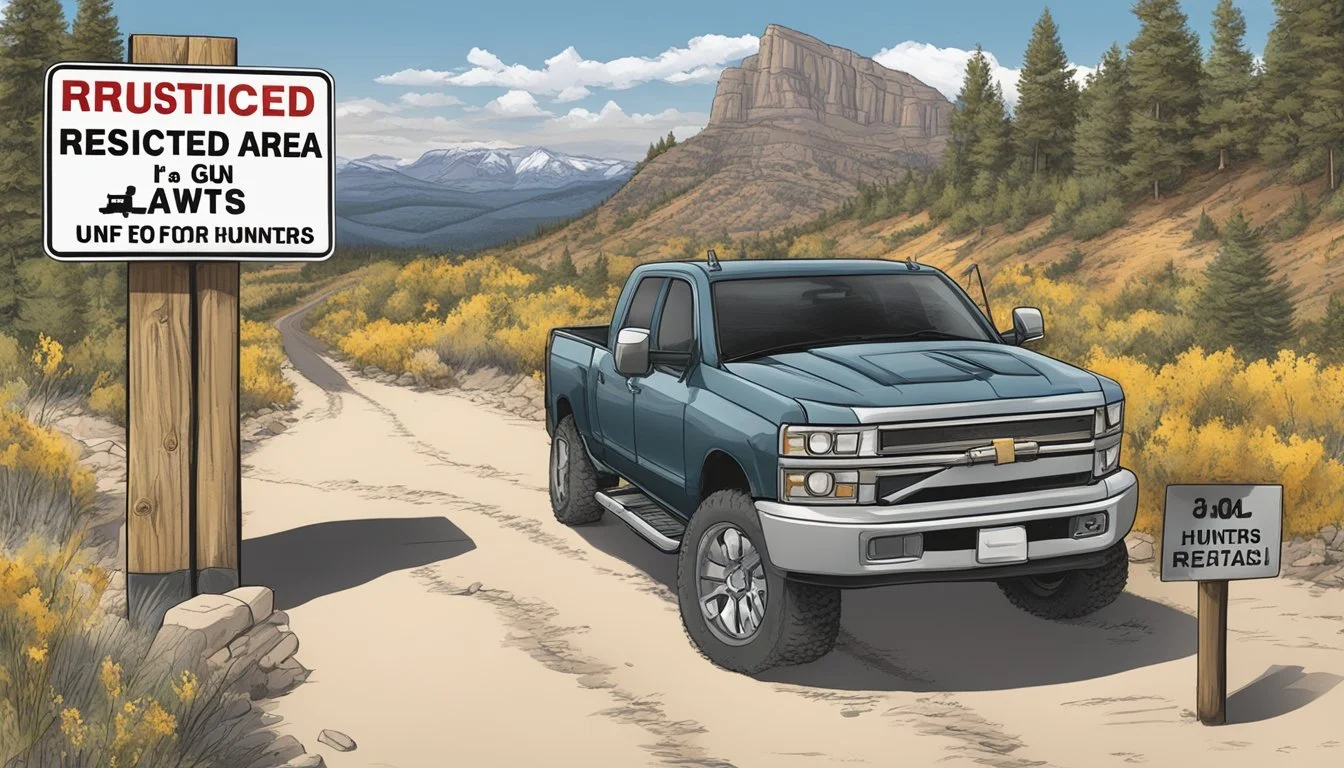
Hunters in Utah must navigate various restrictions that regulate where they can legally use firearms. Knowledge of prohibited locations, species-specific regulations, and seasonal limitations is crucial for compliance with state laws.
Prohibited Locations for Firearm Use
In Utah, it is illegal to use firearms in certain locations. Hunters should be aware of these areas to ensure they do not inadvertently violate state laws:
Schools and Camps: Firearms are not permitted on the premises of any public or private K-12 schools or at organized events like summer camps.
Courthouses and Government Buildings: Firearm use is banned in all courthouses and buildings utilized for federal or state government functions.
Airports: The secure areas of airports are off-limits for the use of firearms.
State Parks and Recreation Areas: While hunting may be allowed in some state parks, it often comes with stringent conditions and the requirement of special permits.
Private Property: Hunters must obtain explicit permission from landowners to hunt or carry firearms on private property.
Special Regulations for Specific Species
Utah imposes special regulations that hunters must adhere to when targeting certain species. For instance:
Elk and Moose: There may be specific limitations on the technology that can be used to hunt these species, as well as designated zones where they can be hunted.
General Season Deer Hunts: The Utah Wildlife Board may enforce mandatory harvest reporting for deer to help manage and preserve the population.
Hunting During Specific Seasons and Conditions
Hunting in Utah is often governed by the season and specific conditions set by regulatory authorities:
General Limitations: Certain periods throughout the year are declared as hunting seasons for different species. Hunting outside these designated times is illegal.
Exceptions: Some exceptions exist for hunting pests or for hunters participating in controlled conservation efforts. These exceptions typically require additional permits or permissions.
Seasonal Restrictions: Additional rules may apply for use of weapons during specific types of seasons, such as archery or muzzleloader seasons, to ensure safety and fair chase principles.
Self-Defense Laws and Hunter Protection
In Utah, hunters are subject to state-specific regulations that govern the use of firearms for self-defense. Understanding these laws ensures that hunters can protect themselves within the bounds of the law while engaging in hunting activities.
Castle Doctrine and Stand Your Ground Law
Utah's self-defense laws provide robust protections for hunters through the Castle Doctrine and Stand Your Ground Law.
Castle Doctrine: This legal doctrine gives individuals the right to use reasonable force, including deadly force, to defend themselves within their homes, vehicles, or any place they legally occupy against an intruder. Under this doctrine, there is no duty to retreat before defending oneself in these specific locations.
Applicable locations for hunters:
Homes
Temporary lodging (e.g., hunting cabins)
Personal vehicles
Stand Your Ground Law: Utah’s Stand Your Ground Law extends self-defense rights beyond one's property. It allows individuals to stand their ground and use force, even deadly force, in public spaces if they reasonably believe it is necessary to prevent death or serious injury to themselves or others.
Key points for hunters:
No duty to retreat in any place where they have a legal right to be
Use of force must be in response to an imminent threat
Hunters should be cognizant that these laws are framed around the concept of "reasonable belief" of imminent harm, a standard which requires a factual basis for the perceived threat. They must also ensure that their use of force is proportionate to the threat encountered.

