
The Shelf Life of Supplements and Nutraceuticals
Key Factors Affecting Potency and Safety

Understanding the shelf life of supplements and nutraceuticals is important for anyone who relies on these products for health benefits. Most supplements and nutraceuticals do not become unsafe after their expiration date, but their potency and effectiveness may decrease over time. The actual shelf life depends on the type of product, storage conditions, and packaging.
Nutritional supplements and natural health products are generally labeled with an expiration or "best by" date to indicate until when their potency is guaranteed by the manufacturer. Factors such as exposure to heat, light, and moisture can affect the stability and longevity of these products.
Knowing how and when supplements lose strength can help people make more informed decisions about the timing and storage of their natural health products. This information can also prevent waste and ensure maximum benefits from the products being used.
Defining Shelf Life for Supplements and Nutraceuticals
Shelf life sets the timeline during which supplements and nutraceuticals are expected to remain safe and effective. Several factors determine this period, including ingredient stability, packaging, storage conditions, and the type of supplement, such as vitamins or herbal extracts.
Difference Between Shelf Life and Expiration Dates
Shelf life refers to the period during which a dietary supplement retains its claimed potency, quality, and safety when stored as recommended. Expiration date marks the end of this period and indicates when the product may no longer guarantee the label-stated amounts of nutrients or active compounds.
Manufacturers use stability testing to estimate shelf life and set expiration dates. While some supplements, like multivitamins, retain much of their potency after the expiration date, others, such as probiotics, may quickly lose effectiveness past this point.
Key Points Table
Term Meaning Shelf Life Safe, effective use period under recommended storage Expiration Date Official end-point for guaranteed potency and safety
Key Factors Influencing Shelf Life
The stability of supplements depends on both the chemical nature of the ingredients and external factors. Exposure to heat, humidity, and light can degrade certain vitamins and active compounds, shortening shelf life.
Formulation differences also matter. For instance, tablets may protect sensitive nutrients better than powders or liquids. Packaging—such as amber glass bottles—can offer more resistance against moisture and light than plastic containers.
To extend shelf life, it’s recommended to:
Store supplements in a cool, dry place.
Seal containers tightly after each use.
Avoid exposing them to direct sunlight.
Importance of Shelf-Life for Health and Wellness
Using supplements within their shelf life is essential for maintaining intended health benefits. Consuming expired products may result in reduced potency, meaning users might not receive the expected levels of vitamins, minerals, or other nutrients.
In some cases, expired supplements may introduce minor safety concerns, such as changes in texture, taste, or appearance. However, most supplements do not become harmful immediately after expiration, but their effectiveness may decline.
Selecting products with appropriate shelf life and monitoring expiration dates supports health and wellness goals by ensuring supplements deliver their intended support.
Principal Determinants of Stability
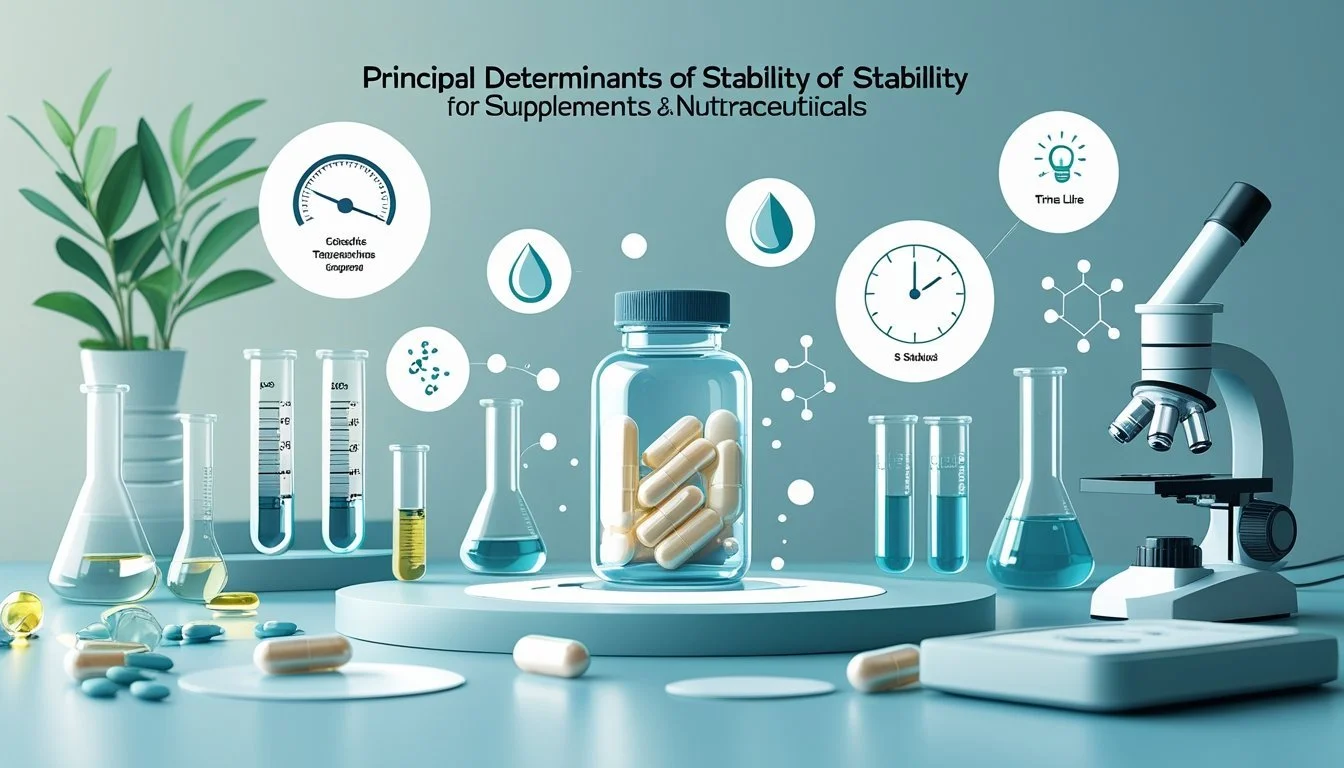
The stability of supplements and nutraceuticals depends on multiple controlled and environmental factors. Key contributors include temperature, humidity, packaging, light, oxygen, pH, and the product's formulation.
Temperature and Humidity Effects
Temperature and humidity are primary drivers of chemical and physical changes in supplements. High temperatures accelerate the degradation of some vitamins, such as vitamin C and some B vitamins, and promote the breakdown of lipids.
Similarly, elevated humidity can lead to moisture absorption. This is particularly problematic for hygroscopic ingredients like amino acids and minerals, which may solidify or clump when exposed to moisture. Excess water can also promote microbial growth or hydrolysis reactions, affecting potency.
Manufacturers recommend storage in cool, dry environments to minimize these risks. By controlling both temperature and humidity, the loss of efficacy and safety risks from accelerated decomposition can be reduced.
A summary table can be useful:
Factor Potential Effect on Stability High Temp Increased degradation, color changes High Humidity Clumping, microbial growth, hydrolysis
Role of Packaging and Storage
Packaging offers a barrier against environmental stressors. Air-tight, moisture-resistant packaging is essential for protecting sensitive compounds from oxygen and humidity.
Opaque or amber-colored containers help reduce light exposure. Blister packs and desiccant packets provide further protection, especially for tablets and capsules. Resealable caps ensure those supplements retain their potency through regular use.
Storage conditions also play a role. For example, placing supplements away from heat sources or direct sunlight prolongs shelf life. Improperly sealed packages contribute to rapid product degradation and reduced label claim accuracy.
Impact of Light Exposure and Oxygen
Light, especially UV radiation, can cause the breakdown of light-sensitive ingredients such as riboflavin and certain botanical extracts. Oxygen exposure causes oxidative degradation, compromising product efficacy and sometimes leading to off-odors, rancidity, or color changes.
Antioxidant ingredients help reduce oxidative damage, but their effectiveness is not absolute. Oxygen-impermeable packaging and nitrogen flushing are common industry methods to minimize these reactions, especially for oil-rich or fat-soluble supplements.
Always storing products in their original packaging ensures continued protection from both light and oxygen throughout their shelf life.
pH and Formulation Considerations
The chemical stability of supplements is influenced by their pH and how they are formulated. Some compounds are more stable in acidic environments; others require neutral or basic pH to prevent hydrolysis or decomposition.
For example, effervescent tablets and probiotic powders require specific pH buffers. The use of stabilizers, chelating agents, and excipients can help to improve overall product shelf life.
The choice of physical form—tablet, capsule, liquid, or powder—also dictates the susceptibility to environmental factors. Liquids, in particular, may require preservatives or special formulations due to higher vulnerability to microbial contamination and chemical breakdown.
Understanding Degradation Pathways and Loss of Potency
Degradation can reduce the strength, purity, and efficacy of supplements and nutraceuticals. Knowing the main routes and consequences of degradation is essential for maintaining product quality and ensuring consumers receive the expected benefits.
Chemical and Physical Degradation
Supplements face both chemical and physical degradation pathways during storage and transportation. Chemical degradation often includes hydrolysis, oxidation, and photodegradation. For example, vitamin C oxidizes quickly in the presence of light and air, reducing its potency over time.
Physical degradation involves changes such as moisture uptake, caking, discoloration, or tablet disintegration. These changes do not always result in loss of potency but can affect product appearance and stability. Improper storage conditions, such as high humidity or temperature fluctuations, accelerate these pathways.
Manufacturers conduct stability testing, often using real-time and accelerated conditions, to predict and mitigate degradation. Understanding these processes allows for better formulation, packaging, and storage recommendations that help preserve product strength and shelf life.
Loss of Strength, Purity, and Efficacy
Degradation often leads to loss of strength, meaning the active ingredient's concentration drops below labeled amounts. Purity can decline if by-products from decomposition accumulate, which may have unknown safety implications. Efficacy is directly linked to both strength and purity, as reduced potency can make a supplement less effective.
Quality standards typically require that products maintain at least 90% of their labeled potency through shelf life. Loss of efficacy may also result from interactions with excipients or packaging components, or from microbial contamination, particularly in probiotics or botanicals.
Routine testing measures parameters such as potency, purity, appearance, and microbial limits. Adherence to these criteria ensures that product efficacy and consumer safety are maintained throughout the intended shelf life.
Stability Testing Strategies
Scientific stability testing is a key part of ensuring that supplements and nutraceuticals remain effective and safe over their expected shelf life. This involves methods that assess ingredient potency, degradation, appearance, and safety under various storage conditions.
Real-Time Stability Testing
Real-time stability testing is the standard method for determining how a dietary supplement or nutraceutical performs under normal storage conditions. Samples are stored at recommended temperatures and humidity levels, then analyzed at fixed intervals.
Common parameters tested include active ingredient concentration, physical changes, moisture, and microbial growth. These studies use a defined stability testing protocol, laid out in advance, to ensure consistent and repeatable measurements.
This type of testing is thorough, as it replicates actual storage scenarios. The main drawback is that it is time-intensive, often lasting from 12 months up to several years, to match the intended shelf life. However, the results provide the most accurate estimate of how long a product will remain stable on the market, making real-time studies a core part of any stability testing program.
Accelerated Stability Testing
Accelerated stability testing speeds up the degradation process by exposing samples to higher-than-normal temperatures and humidity. This strategy allows manufacturers to make quick predictions about shelf life, sometimes in a matter of weeks or months.
Protocols in these accelerated studies often include storage at 40°C with 75% relative humidity, among other stressful conditions. Measurements are taken frequently to identify significant changes in product quality.
While accelerated stability testing offers faster results, it may not always capture how a product will perform during actual storage. Some nutrient or ingredient reactions may not scale with increased temperature, leading to underestimation or overestimation of shelf life. Therefore, these results are generally used for preliminary guidance, not as a replacement for real-time stability studies.
Long-Term Storage and Studies
Long-term studies involve storing products under defined conditions that represent typical distribution and consumption environments, such as room temperature and standard humidity. These studies follow a specific protocol and are crucial for validating shelf life claims established by real-time and accelerated stability tests.
Test points are usually scheduled at multiple intervals, such as 0, 3, 6, 12, and 24 months. At each point, key parameters such as potency, color, odor, and microbial contamination are measured. These results inform labeling claims about expiration and ensure compliance with health regulations.
Proper long-term storage studies also help manufacturers understand the impact of factors like packaging material, closure systems, and exposure to light or oxygen. They are central to a robust stability testing program, helping to ensure that products maintain quality until the end of their shelf life.
Analytical Methods for Evaluating Shelf Life
Accurate shelf life determination for supplements and nutraceuticals relies on specialized analytical techniques. Selecting validated methods is critical to measure the stability of active ingredients and detect degradation.
High-Performance Liquid Chromatography (HPLC)
HPLC is a central technique in evaluating supplement shelf life. It allows for the precise quantification of active compounds, excipients, and potential degradation products.
HPLC separates ingredients in a mixture based on their chemical properties and retention times. This makes it possible to detect even small changes in formulation or purity.
Manufacturers rely on HPLC results to confirm that the ingredients remain within specified limits throughout storage. Regular HPLC testing provides data to support product labels and expiration dates. It is also used to study the impact of packaging and storage conditions on product stability.
Spectrophotometry and Other Analytical Techniques
Spectrophotometry measures how much light a sample absorbs at specific wavelengths. It is a quick method to estimate the concentration of certain nutrients or compounds in supplements.
While spectrophotometry is useful for routine quality checks, it is typically less specific than HPLC. It is effective for compounds that absorb UV or visible light, such as some vitamins.
Other analytical techniques—such as mass spectrometry, gas chromatography, and titrations—play supporting roles. These methods can detect impurities, assess product uniformity, and confirm identity. Using multiple techniques gives a broader picture of product stability over time.
Validation of Analytical Methods
Analytical methods used in shelf life evaluation must be validated for their intended purpose. Validation ensures methods are accurate, precise, repeatable, and specific for the target analytes.
A validation process typically assesses:
Accuracy (closeness of results to true value)
Precision (consistency among repeat tests)
Specificity (ability to quantify the analyte without interference)
Linearity (proportional response to analyte concentration)
Range (span between lowest and highest quantifiable amounts)
Validated methods are required to meet regulatory standards and support scientific confidence in the shelf life claims. Documentation of validation results is often necessary for compliance and audits.
Regulatory Standards and Compliance Considerations
Regulatory oversight sets strict expectations for supplement shelf life, including product quality, safety, and efficacy. Standards address manufacturing procedures, stability data requirements, and mandatory labeling that ensure consumers get reliable products.
FDA Guidelines and ICH Guidelines
The U.S. Food and Drug Administration (FDA) regulates dietary supplements under the Dietary Supplement Health and Education Act (DSHEA). Under this law, supplement manufacturers must ensure the safety and proper labeling of their products before marketing.
FDA guidelines require that shelf life claims be supported by stability data showing the product meets quality and potency specifications for the duration listed on the label. Manufacturers must document ingredients, expiration dates, and conditions affecting stability, such as temperature and humidity.
The International Council for Harmonisation (ICH) provides additional guidance, especially relevant to global manufacturers. ICH guidelines standardize stability testing, storage conditions, and documentation. This helps ensure supplements and nutraceuticals meet similar expectations for shelf life and quality across different countries and regions.
Good Manufacturing Practice (GMP)
Good Manufacturing Practice (GMP) regulations are central to supplement production. The FDA enforces 21 CFR Part 111, which outlines GMP requirements specific to dietary supplements sold in the United States. These requirements cover all stages: ingredient sourcing, manufacturing, packaging, labeling, and storage.
Key elements include:
Consistent quality control procedures
Regular equipment cleaning and maintenance
Accurate recordkeeping
Employee training
Batch testing to ensure compliance with established specifications
Facilities must implement systems to prevent contamination, mislabeling, and any deviation from required quality standards. GMP compliance is routinely verified through FDA inspections and can lead to warnings or recalls if standards are not met.
Labeling and Regulatory Requirements
Labeling rules for supplements and nutraceuticals are detailed and regulated. U.S. regulations require that supplement labels include ingredient lists, manufacturer or distributor contact information, lot number, suggested use, disclaimers, and an expiration or best-by date if a shelf life claim is made.
Claims about shelf life or potency must be substantiated by stability data, and the product must remain within labeled specifications until the listed expiration date. Misleading labels or unproven health claims can trigger FDA action, including product seizures or recalls.
European Union and other regions have additional requirements, such as registration and notification obligations before supplements can be marketed. Labels must convey accurate information to ensure informed consumer choices and regulatory compliance.
Specific Considerations for Probiotics and Vitamins
Probiotics and vitamins have distinct stability needs that influence both how they are stored and how long they remain effective. Shelf life can be affected by factors such as exposure to heat, moisture, and air as well as the type of formulation and packaging used.
Unique Stability Challenges
Probiotics are live microorganisms, making their stability particularly sensitive to temperature, humidity, and oxygen. If probiotics lose viability during storage, their intended health benefits may be compromised. Most require refrigeration, but certain strains are more resilient and can withstand room temperature if formulated properly.
Vitamins, on the other hand, are non-living compounds but are also vulnerable to degradation. For example, many water-soluble vitamins like vitamin C and B-complex can break down with heat, light, or prolonged exposure to air. Fat-soluble vitamins (A, D, E, K) are more stable but can still deteriorate, especially in humid conditions.
For both probiotics and vitamins, incorrect storage can shorten shelf life and reduce potency. Supplement and nutraceutical manufacturers must consider ingredient interactions, as some combinations increase degradation risks.
Formulation and Packaging Solutions
Advanced formulation techniques and robust packaging significantly extend shelf life. Probiotics benefit from microencapsulation or freeze-drying, which can shield live cultures from oxygen and moisture until consumption. Using plant-derived raw materials in capsule shells can also help preserve stability throughout the product’s shelf life.
Vitamins are commonly protected using antioxidants and desiccants that absorb moisture. Opaque or amber-colored bottles block out light, further reducing the risk of degradation. Companies often use airtight, tamper-proof containers and individually sealed blister packs to minimize air exposure.
Proper labeling, including storage instructions and expiry dates, is essential so consumers know how to handle products to maintain their effectiveness. Storage recommendations may include refrigeration for certain probiotics or keeping vitamin supplements in a cool, dry environment. The use of these solutions helps balance nutraceutical stability with consumer convenience.
Ensuring Product Quality Throughout Shelf Life
Products must be maintained to specific quality and safety standards to protect consumer health and ensure product effectiveness over time. Scientific approaches and strict protocols are required at every stage to preserve the integrity of supplements and nutraceuticals.
Quality Assurance and Safety Measures
Quality assurance depends on stability testing, which verifies that key ingredients retain their potency, purity, and safety throughout the labeled shelf life. Stability testing also checks for unwanted changes in physical properties, such as color, odor, and texture, which could indicate product degradation.
Monitoring environmental factors such as temperature, humidity, and light exposure is essential. Excessive heat or moisture can accelerate breakdown and lower efficacy, so products are often stored and shipped in controlled conditions.
Manufacturers use validated laboratory methods, including chemical analysis and microbial testing, to ensure that no harmful contaminants develop as the product ages. Regular batch testing helps ensure consistency and allows for the early detection of quality issues.
Role of Supplement Manufacturers
Supplement manufacturers are responsible for establishing shelf life through scientific research and validated stability programs. They develop detailed protocols for ingredient testing, formulation review, and packaging selection to protect the product from degradation.
To comply with regulatory guidelines, manufacturers document all procedures and outcomes, providing traceability and accountability. They label products with expiration or best-before dates, guaranteeing potency and consumer safety as promised.
Manufacturers continuously improve testing and quality assurance based on new research findings and changes in industry standards. These ongoing efforts build trust by demonstrating transparency and a commitment to upholding quality standards throughout a product’s lifecycle.
Innovation Trends in Shelf Life Extension
Recent advances in supplement and nutraceutical shelf life focus on extending product stability and maintaining efficacy by using cutting-edge technology and materials. Brands are actively improving formulation strategies and packaging to address both regulatory and market demands.
Emerging Technologies in Stability Enhancement
Manufacturers are increasingly turning to active and intelligent packaging. These systems can control moisture, oxygen, and microbial exposure, reducing degradation and preserving ingredient potency over time. For example, active packaging inserts can scavenge oxygen or emit antioxidants, blocking common pathways of nutrient loss.
High-pressure processing (HPP) and microwave-assisted treatments are being researched to reduce contaminant risk without exposing ingredients to heat. This technology helps preserve heat-sensitive components such as probiotics and certain vitamins. Nanotechnology offers another promising approach, where encapsulation techniques protect volatile or unstable compounds.
Developments in antimicrobial films and coatings, containing natural extracts or synthetic agents, provide another layer of protection for capsule and tablet supplements. These innovations can extend product shelf life by a significant margin, depending on the supplement’s composition and the package design.
Novel Approaches to Product Development
Product developers now focus on ingredient composition and formulation to reduce reactivity and instability. Microencapsulation, for instance, traps bioactives in protective shells, shielding them from air, light, and moisture. This method also minimizes unpleasant tastes or odors without altering potency.
Formulators may incorporate natural antioxidants, such as tocopherols or plant polyphenols, directly into the product matrix. This approach slows down oxidative degradation, maintaining bioactivity over longer periods. The use of chelators to stabilize minerals and enzymes also continues to gain popularity.
Selective ingredient sourcing, where raw materials with inherently lower reactivity or superior stability are chosen, is another key trend. Tableting aids and excipients are being optimized to further enhance the physical stability of finished products, supporting a longer shelf life even under variable storage conditions.